Breeds / Giant
Mastiff puppies
Calm and affectionate with their own people but capable of guarding, and usually indifferent with strangers. Timidity is unacceptable in the breed.
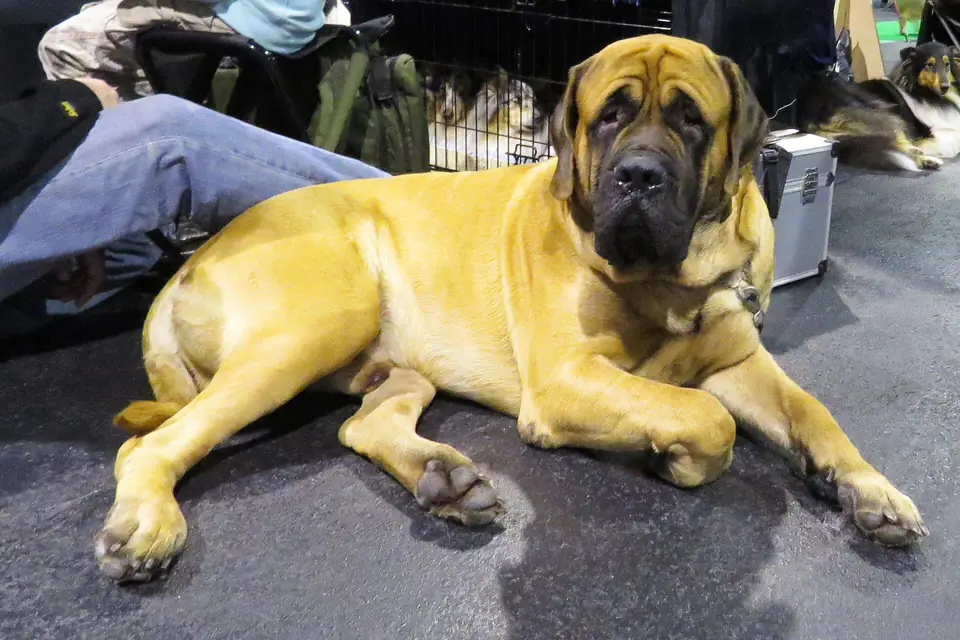
The facts
- Size class Giant
- Country of origin Great Britain
- Adult weight 54.4 to 104.3 kg
- Adult weight in pounds 120 to 230 lb
- Adult height 70 to 76 cm
- Energy level Moderate
- Grooming Low
- Coat type Short double
- Shedding Moderate
- Typical lifespan 6 to 10 years
- Good with children Reliably good
- Good with other dogs Fine with supervision
About the Mastiff
The Mastiff descends from the heavy guarding dogs of Britain, kept for centuries to watch property and to hold large game. This is a giant breed, 70 to 76 cm at the shoulder and anywhere from 54.4 to 104.3 kg, with a broad head, a short dark muzzle and a short double coat. Despite the mass, the temperament is famously steady: calm indoors, undemonstrative with strangers, and deeply attached to their own household. Timidity and unprovoked aggression are both counted as faults in the breed.
An adult Mastiff is a low energy dog that still needs daily walking, a mile or two, plus free movement in a safe space. The growth period is the delicate part, with no repeated stairs, no jumping down from height and short walks only, or the joints pay for it later. Grooming is a brush every few days, more during the twice yearly moult, plus cleaning the facial wrinkles and ears. Owners underestimate the drool, the feeding cost, and how short the lifespan is at 6 to 10 years.
What to expect at eight weeks
At eight weeks a Mastiff puppy is sleeping around 18 to 20 hours a day, is not house trained, and cannot hold on for more than an hour or two at a stretch. A giant breed puppy at eight weeks is already heavy and will keep growing for up to two years. Controlled growth matters more here than in any other size class, so a large breed specific puppy food and no overfeeding. Expect moderate energy, in short bursts separated by long naps. Grooming is straightforward, but start handling the coat, feet and ears in week one anyway so it is never a fight later. The socialisation window is open and closing: everything they meet calmly now, from vacuum cleaners to men in hats, is easier for the rest of their life.
Health worth knowing about
Conditions this breed is reported to be predisposed to. Predisposed does not mean inevitable, it means ask about it.
- Hip dysplasia, screened under the BVA/KC Hip Dysplasia Scheme
- Elbow dysplasia, screened under the BVA/KC Elbow Dysplasia Scheme
- Hereditary eye disease including progressive retinal atrophy, screened under the BVA/KC/ISDS Eye Scheme, with DNA testing available for PRA
- Gastric dilatation volvulus, a surgical emergency, risk rises with a deep chest, prophylactic gastropexy is often recommended
- Entropion and ectropion, diagnosed on veterinary eye examination and corrected surgically
- Degenerative myelopathy, detectable by DNA test alongside clinical signs
Your Mastiff puppy's first six months
- Vaccination schedule, dated for your country.
- Worming and parasite schedule.
- Feeding calculator. Set expected adult size to Giant for a Mastiff.
- Adult size predictor, to check growth against the 54.4 to 104.3 kg adult range.
- Puppy names and the first week checklist.
Kit sizes: crate 48 inch (48 x 30 x 32 in, 122 x 76 x 81 cm) for an adult of up to 104.3 kg, the largest size in the chart, which tops out at 49.9 kg, so measure the dog before you buy; chew toys made for large breeds. Worked out the same way as the crate size calculator. PetMD bases a crate on the dog's own measurements, not weight or breed alone, so measure once the puppy is home.
Buying guides for this
Other giant breeds
More on the Mastiff
Previous: Maremma Sheepdog · Next: Miniature American Shepherd
Not veterinary advice. Breed information is general. Your own dog, and your own vet, always win.
Sources
- akc.org for adult weight and height, life expectancy, energy, grooming, shedding and the temperament ratings, coat type and health notes
- fci.be for country of origin
- Health notes from Mastiff breed information at https://www.akc.org/dog-breeds/mastiff/. Discuss any of these with your own vet.
Photo: Томасина, CC BY-SA 3.0, via Wikimedia Commons, cropped. All photographers are listed on the photo credits page.