Breeds / Giant
St. Bernard puppies
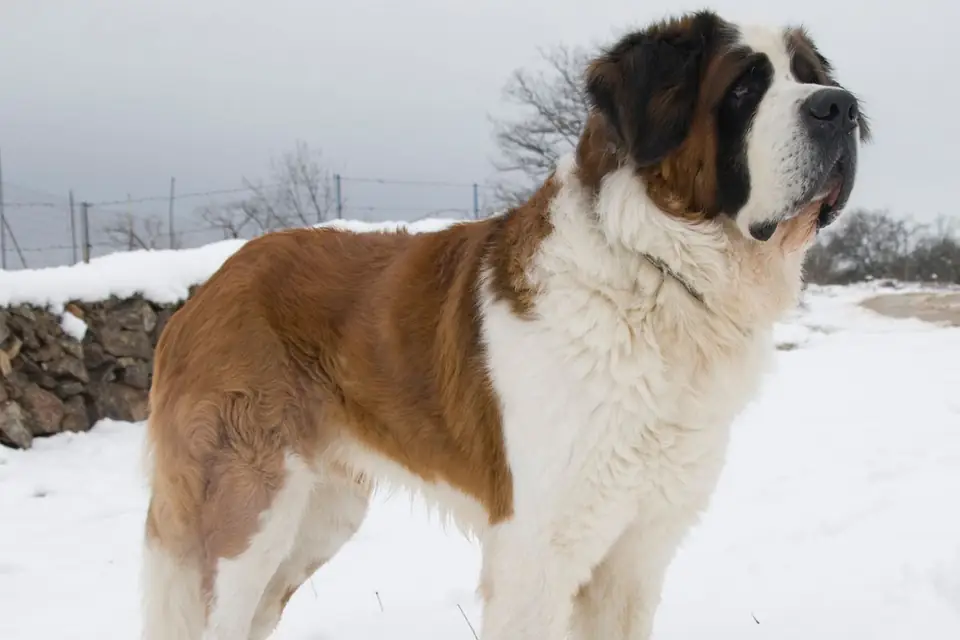
Gentle, patient and calm, the Saint Bernard is a Swiss mountain rescue breed that is tolerant with children and slow to anger, though very large and heavy to manage.
The facts
- Size class Giant
- Country of origin Switzerland
- Adult weight 54.4 to 81.6 kg
- Adult weight in pounds 120 to 180 lb
- Adult height 66 to 76 cm
- Energy level Moderate
- Grooming Moderate
- Coat type Short smooth and rough and double
- Shedding Moderate
- Typical lifespan 8 to 10 years
- Good with children Reliably good
- Good with other dogs Fine with supervision
About the St. Bernard
The Saint Bernard is named after the hospice on the Great St Bernard Pass in the Swiss Alps, where monks kept large dogs to escort travellers and find people lost in snow. This is a giant, 66 to 76 cm tall and 54.4 to 81.6 kg, and comes in both a short coated and a long coated variety. Temperament is why the breed survived as a pet rather than a working dog: steady, tolerant, slow to react, and gentle with children when properly socialised and supervised.
A Saint needs less exercise than their size suggests, one long walk or a half hour play session a day, though puppies should be kept off long runs and hard surfaces while they grow. Weekly brushing turns daily during the two heavy sheds a year. Expect drool and expect large bills. Heat is a genuine risk, so a cool place to rest and plenty of water are essential in summer. Training has to happen early, while lifting the dog is still possible. The 8 to 10 year lifespan surprises many owners.
What to expect at eight weeks
At eight weeks a St. Bernard puppy is sleeping around 18 to 20 hours a day, is not house trained, and cannot hold on for more than an hour or two at a stretch. A giant breed puppy at eight weeks is already heavy and will keep growing for up to two years. Controlled growth matters more here than in any other size class, so a large breed specific puppy food and no overfeeding. Expect moderate energy, in short bursts separated by long naps. Grooming needs are moderate, so build the brushing habit now while the coat is still short and easy. The socialisation window is open and closing: everything they meet calmly now, from vacuum cleaners to men in hats, is easier for the rest of their life.
Health worth knowing about
Conditions this breed is reported to be predisposed to. Predisposed does not mean inevitable, it means ask about it.
- Bloat and gastric torsion, a surgical emergency in deep chested dogs
- Hip and elbow dysplasia, which breeding stock should be x-rayed and scored for
- Entropion and ectropion, eyelid faults found on veterinary eye examination
- Dilated cardiomyopathy, detected by cardiac auscultation and echocardiogram
- Osteosarcoma, a bone cancer of giant breeds, diagnosed by x-ray and biopsy
- Heat intolerance, managed with shade, water and a cool place to rest rather than tested for
Your St. Bernard puppy's first six months
- Vaccination schedule, dated for your country.
- Worming and parasite schedule.
- Feeding calculator. Set expected adult size to Giant for a St. Bernard.
- Adult size predictor, to check growth against the 54.4 to 81.6 kg adult range.
- Puppy names and the first week checklist.
Kit sizes: crate 48 inch (48 x 30 x 32 in, 122 x 76 x 81 cm) for an adult of up to 81.6 kg, the largest size in the chart, which tops out at 49.9 kg, so measure the dog before you buy; chew toys made for large breeds. Worked out the same way as the crate size calculator. PetMD bases a crate on the dog's own measurements, not weight or breed alone, so measure once the puppy is home.
Buying guides for this
Other giant breeds

More on the St. Bernard
Previous: Sproodle · Next: Stabyhoun
Not veterinary advice. Breed information is general. Your own dog, and your own vet, always win.
Sources
- akc.org for adult weight and height, life expectancy, energy, grooming, shedding and the temperament ratings, coat type and health notes
- fci.be for country of origin
- Health notes from St. Bernard breed information at https://www.akc.org/dog-breeds/st-bernard/. Discuss any of these with your own vet.
Photo: Rafael Dominguez Rodriguez, CC BY-SA 4.0, via Wikimedia Commons, cropped. All photographers are listed on the photo credits page.