Breeds / Toy
Papillon puppies
Lively, intelligent and friendly, with no aggression, and always alert. A small and highly trainable companion that competes successfully in obedience and agility.
The facts
- Size class Toy
- Country of origin Belgium, France
- Adult weight 2.3 to 4.5 kg
- Adult weight in pounds 5 to 10 lb
- Adult height 20 to 28 cm
- Energy level High
- Grooming Moderate
- Coat type Medium silky
- Shedding Moderate
- Typical lifespan 14 to 16 years
- Good with children Reliably good
- Good with other dogs Fine with supervision
About the Papillon
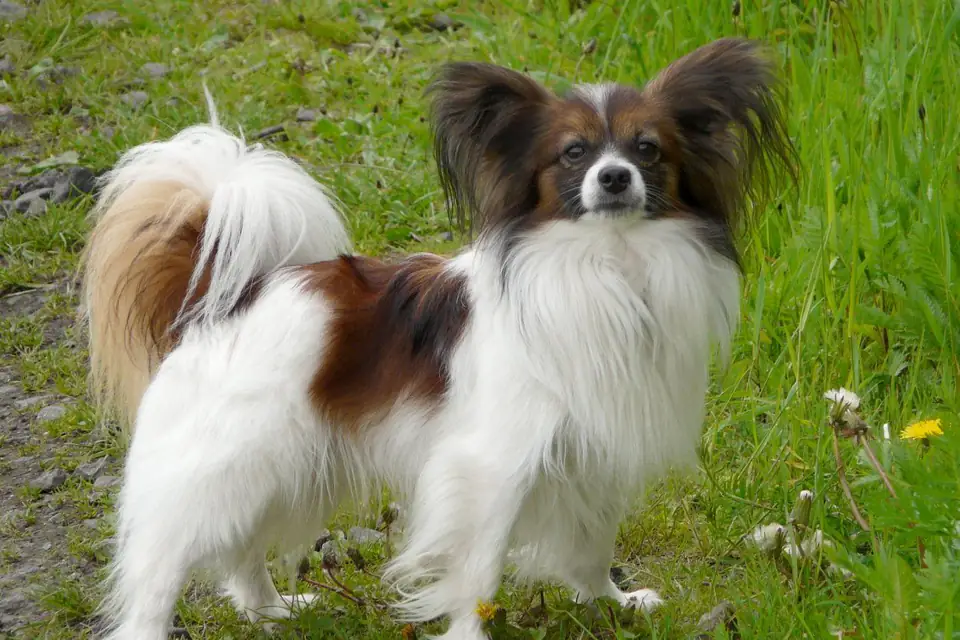
The Papillon is a continental toy spaniel, painted in European portraits for centuries and refined in Belgium and France, and the breed's name comes from the fringed upright ears that suggest a butterfly. This is a light, fine boned dog of 20 to 28 cm and 2.3 to 4.5 kg, with a long silky coat and a plumed tail carried over the back. They are one of the brightest of the toy breeds, busy, curious and quick to learn, and they hold their own in obedience and agility against dogs many times their size.
For a long coated breed it is easy work, because there is no undercoat. Comb the ear fringes, the thigh hair and behind the legs a few times a week to prevent mats, with a fuller session monthly. Exercise is a daily walk plus indoor fetch and training games. They rate highly with children, though a dog this light is easily injured, so supervision is not optional. Keep on top of the nails and the dewclaws. Do not let this bold toy dog run at much larger animals unchecked.
What to expect at eight weeks
At eight weeks a Papillon puppy is sleeping around 18 to 20 hours a day, is not house trained, and cannot hold on for more than an hour or two at a stretch. A toy breed puppy at eight weeks is small enough to be genuinely fragile. They can be hurt by a jump off a sofa and by being stepped on, and toy breeds are prone to low blood sugar, so they need frequent small meals rather than two big ones. This is a high energy breed. At eight weeks that shows up as intensity rather than stamina, and they will need a job to do long before they need long walks. Grooming needs are moderate, so build the brushing habit now while the coat is still short and easy. The socialisation window is open and closing: everything they meet calmly now, from vacuum cleaners to men in hats, is easier for the rest of their life.
Health worth knowing about
Conditions this breed is reported to be predisposed to. Predisposed does not mean inevitable, it means ask about it.
- Progressive retinal atrophy (pap-PRA), detectable by DNA test
- Neuronal axonal dystrophy (NAD-PLA2G6), detectable by DNA test
- von Willebrand disease type 1 (vWD1), detectable by DNA test
- Inherited eye disease, screened under the BVA/KC/ISDS Eye Scheme
- Patellar luxation, detected by veterinary palpation and grading of the kneecap
- Open fontanelle, detected by feeling the puppy's skull for a soft spot that should close by 9 to 12 weeks
Your Papillon puppy's first six months
- Vaccination schedule, dated for your country.
- Worming and parasite schedule.
- Feeding calculator. Set expected adult size to Toy for a Papillon.
- Adult size predictor, to check growth against the 2.3 to 4.5 kg adult range.
- Puppy names and the first week checklist.
Kit sizes: crate 22 inch (22 x 14 x 16 in, 56 x 36 x 41 cm) for an adult of up to 4.5 kg; chew toys made for small breeds. Worked out the same way as the crate size calculator. PetMD bases a crate on the dog's own measurements, not weight or breed alone, so measure once the puppy is home.
Buying guides for this
Other toy breeds
More on the Papillon
Previous: Otterhound · Next: Parson Russell Terrier
Not veterinary advice. Breed information is general. Your own dog, and your own vet, always win.
Sources
- akc.org for adult weight and height, life expectancy, energy, grooming, shedding and the temperament ratings, coat type and health notes
- fci.be for country of origin
- Health notes from Papillon breed information at https://www.akc.org/dog-breeds/papillon/. Discuss any of these with your own vet.
Photo: Gvdmoort, CC BY-SA 3.0, via Wikimedia Commons, cropped. All photographers are listed on the photo credits page.