Breeds / Toy
Japanese Chin puppies
Refined, affectionate and almost catlike in the way they climb and groom themselves. Devoted to their own household and quietly reserved with strangers.
The facts
- Size class Toy
- Country of origin Japan
- Adult weight 3.2 to 5 kg
- Adult weight in pounds 7 to 11 lb
- Adult height 20 to 28 cm
- Energy level Moderate
- Grooming Moderate
- Coat type Medium silky
- Shedding Moderate
- Typical lifespan 10 to 12 years
- Good with children Fine with supervision
- Good with other dogs Reliably good
About the Japanese Chin
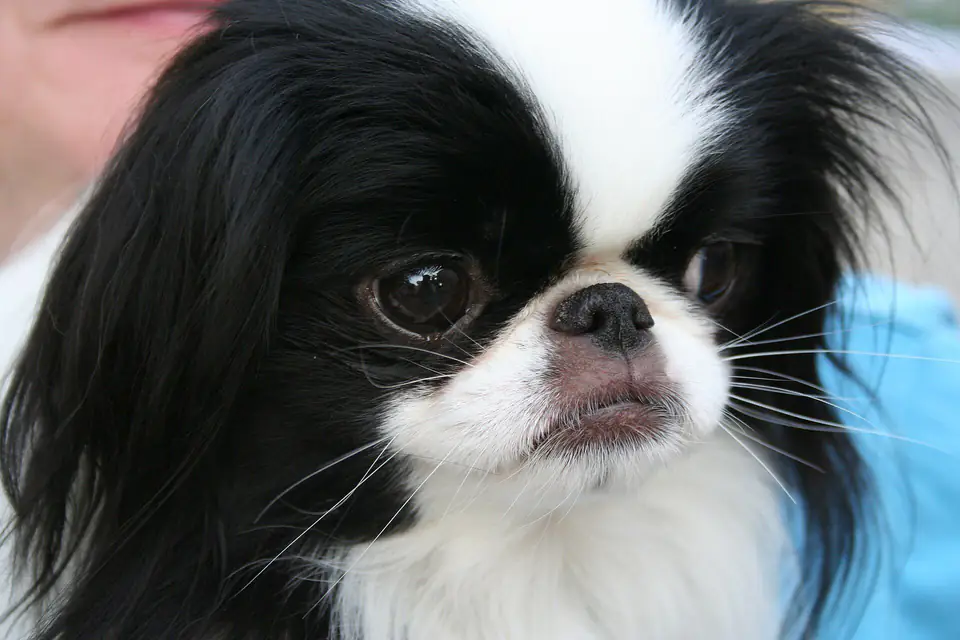
The Japanese Chin was a companion in the Japanese court, developed from small flat faced dogs that arrived from the Asian mainland and were then bred for centuries as an indoor dog for the nobility. They weigh 3.2 to 5 kg and stand 20 to 28 cm, with a broad short muzzle, wide set dark eyes and a silky coat that falls into a mane and feathering. Owners tend to describe them as catlike: they climb onto the backs of chairs, wash their own face and pick their own lap.
The coat looks demanding and is not. Weekly brushing and a bath every month or so keeps it right, though the fast growing nails need regular attention. They suit flats and quiet households, and they rate at the top of the scale for living with other pets. They are reserved with new people, so socialise early. Never let one off lead, because a Chin that has decided to investigate something will simply stop listening. Remember that shortened muzzle on warm days and keep a Chin from overheating.
What to expect at eight weeks
At eight weeks a Japanese Chin puppy is sleeping around 18 to 20 hours a day, is not house trained, and cannot hold on for more than an hour or two at a stretch. A toy breed puppy at eight weeks is small enough to be genuinely fragile. They can be hurt by a jump off a sofa and by being stepped on, and toy breeds are prone to low blood sugar, so they need frequent small meals rather than two big ones. Expect moderate energy, in short bursts separated by long naps. Grooming needs are moderate, so build the brushing habit now while the coat is still short and easy. The socialisation window is open and closing: everything they meet calmly now, from vacuum cleaners to men in hats, is easier for the rest of their life.
Health worth knowing about
Conditions this breed is reported to be predisposed to. Predisposed does not mean inevitable, it means ask about it.
- Patellar luxation, detected on orthopaedic examination
- GM2 gangliosidosis, a fatal neurological disease detectable by DNA test on both parents
- Cataracts, found at an ophthalmologist eye examination
- Early onset heart murmurs, picked up by auscultation at routine vet checks
- Epilepsy, diagnosed by a vet once other causes of seizures are ruled out
- Heat and breathing stress from the shortened muzzle, assessed by a vet on exercise tolerance
Your Japanese Chin puppy's first six months
- Vaccination schedule, dated for your country.
- Worming and parasite schedule.
- Feeding calculator. Set expected adult size to Toy for a Japanese Chin.
- Adult size predictor, to check growth against the 3.2 to 5 kg adult range.
- Puppy names and the first week checklist.
Kit sizes: crate 22 inch (22 x 14 x 16 in, 56 x 36 x 41 cm) for an adult of up to 5 kg; chew toys made for small breeds. Worked out the same way as the crate size calculator. PetMD bases a crate on the dog's own measurements, not weight or breed alone, so measure once the puppy is home.
Buying guides for this
Other toy breeds



More on the Japanese Chin
Previous: Japanese Akitainu · Next: Japanese Spitz
Not veterinary advice. Breed information is general. Your own dog, and your own vet, always win.
Sources
- akc.org for adult weight and height, life expectancy, energy, grooming, shedding and the temperament ratings, coat type and health notes
- fci.be for country of origin
- Health notes from Japanese Chin breed information at https://www.akc.org/dog-breeds/japanese-chin/. Discuss any of these with your own vet.
Photo: LostinTexas (Alex Archambault), CC BY 2.0, via Wikimedia Commons, cropped. All photographers are listed on the photo credits page.