Breeds / Large
Great Pyrenees puppies
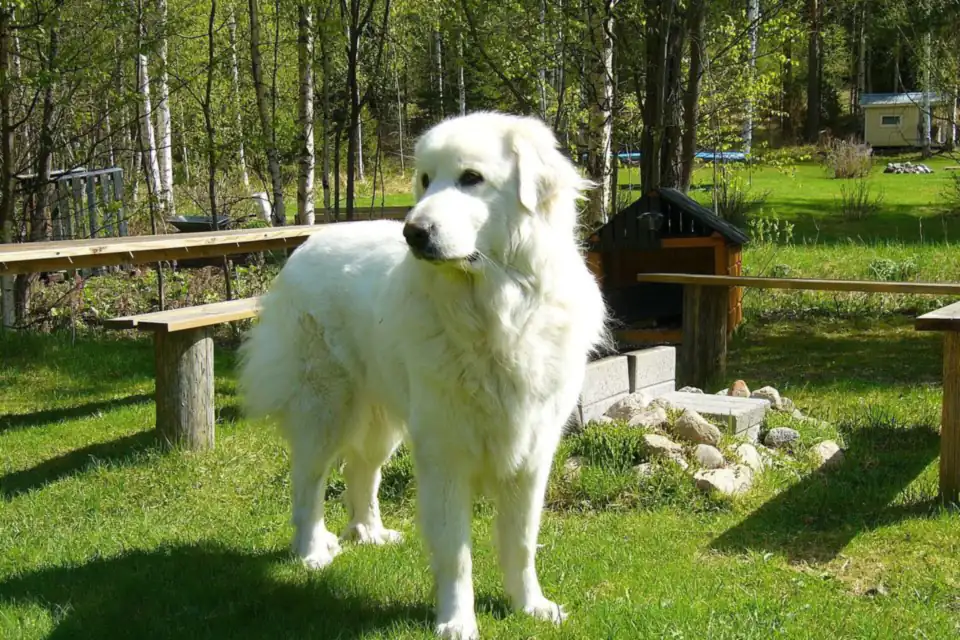
The Great Pyrenees is a livestock guardian with a thick weatherproof coat, usually calm and patient but independent and quick to respond to anything they see as a threat. They bark at night by instinct and roam if the boundary is not secure.
The facts
- Size class Large
- Country of origin France
- Adult weight 38.6 to 45.4 kg
- Adult weight in pounds 85 to 100 lb
- Adult height 64 to 81 cm
- Energy level Moderate
- Grooming Moderate
- Coat type Medium double
- Shedding Moderate
- Typical lifespan 10 to 12 years
- Good with children Fine with supervision
- Good with other dogs Fine with supervision
About the Great Pyrenees
The Great Pyrenees, known in Britain as the Pyrenean Mountain Dog, spent centuries on the French side of the Pyrenees guarding flocks from wolves and bears with no shepherd standing over them. That history explains everything about the dog. They are large and heavy boned, 38.6 to 45.4 kg under a thick weatherproof double coat, usually white, and they are calm and patient by default but perfectly willing to make their own decisions about what counts as a threat.
Exercise needs are moderate, mostly steady walks, but containment is not. A Pyr roams if the boundary is weak, so tall secure fencing and lead walks are the rule. They bark at night because that was the job, which makes them a poor fit for close neighbours. Brush the coat weekly and brace for a spectacular undercoat moult. Training works as negotiation rather than obedience. Do not expect a biddable retriever in a white coat, and please do not let one off lead to test the theory.
What to expect at eight weeks
At eight weeks a Great Pyrenees puppy is sleeping around 18 to 20 hours a day, is not house trained, and cannot hold on for more than an hour or two at a stretch. A large breed puppy at eight weeks looks deceptively normal sized and will roughly double every few weeks for a while. Keep exercise short and low impact, the growth plates are wide open. Expect moderate energy, in short bursts separated by long naps. Grooming needs are moderate, so build the brushing habit now while the coat is still short and easy. The socialisation window is open and closing: everything they meet calmly now, from vacuum cleaners to men in hats, is easier for the rest of their life.
Health worth knowing about
Conditions this breed is reported to be predisposed to. Predisposed does not mean inevitable, it means ask about it.
- Hip and elbow dysplasia, screened by hip and elbow evaluation of breeding stock
- Patellar luxation, a slipping kneecap, found on a patella evaluation
- Gastric dilatation volvulus, a surgical emergency, risk rises with deep chests
- Inherited eye disorders, screened by an ophthalmologist evaluation
- Neurological and immune mediated disorders, which the breed club asks breeders to test for
- Bone cancer and other cancers, which is why persistent lameness should be x-rayed
Your Great Pyrenees puppy's first six months
- Vaccination schedule, dated for your country.
- Worming and parasite schedule.
- Feeding calculator. Set expected adult size to Large for a Great Pyrenees.
- Adult size predictor, to check growth against the 38.6 to 45.4 kg adult range.
- Puppy names and the first week checklist.
Kit sizes: crate 48 inch (48 x 30 x 32 in, 122 x 76 x 81 cm) for an adult of up to 45.4 kg; chew toys made for large breeds. Worked out the same way as the crate size calculator. PetMD bases a crate on the dog's own measurements, not weight or breed alone, so measure once the puppy is home.
Buying guides for this
Other large breeds
More on the Great Pyrenees
Previous: Great Dane · Next: Greater Swiss Mountain Dog
Not veterinary advice. Breed information is general. Your own dog, and your own vet, always win.
Sources
- akc.org for adult weight and height, life expectancy, energy, grooming, shedding and the temperament ratings, coat type and health notes
- fci.be for country of origin
- Health notes from Great Pyrenees breed information at https://www.akc.org/dog-breeds/great-pyrenees/. Discuss any of these with your own vet.
Photo: Cerie at fi.wikipedia, Public domain, via Wikimedia Commons, cropped. All photographers are listed on the photo credits page.