Breeds / Large
Boxer puppies
Equable, biddable, fearless and self-assured, lively and strong with natural guarding instincts.
The facts
- Size class Large
- Country of origin Germany
- Adult weight 22.7 to 36.3 kg
- Adult weight in pounds 50 to 80 lb
- Adult height 55 to 64 cm
- Energy level High
- Grooming Moderate
- Coat type Short smooth
- Shedding Low
- Typical lifespan 10 to 12 years
- Good with children Reliably good
- Good with other dogs Fine with supervision
About the Boxer
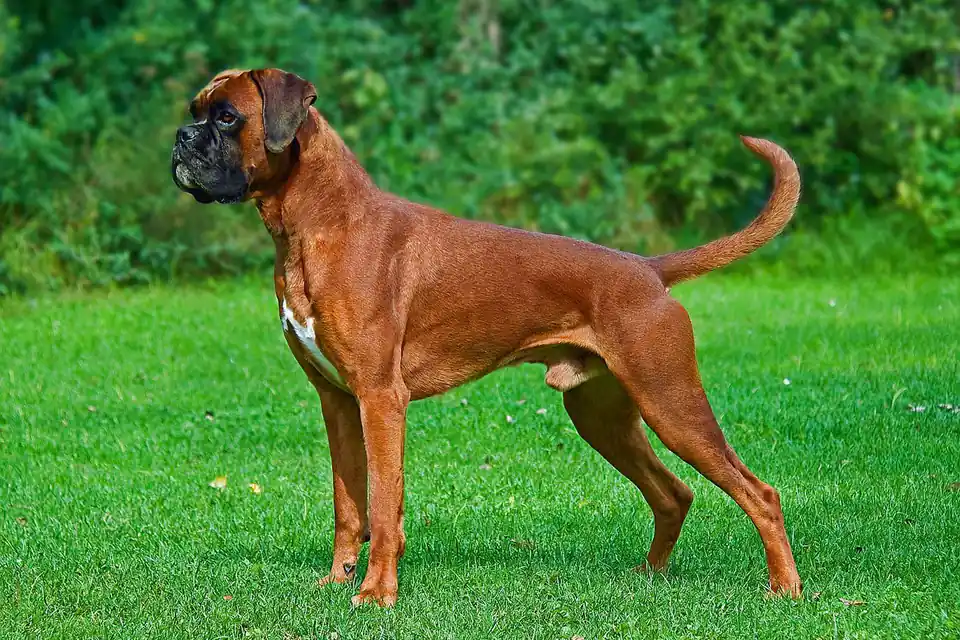
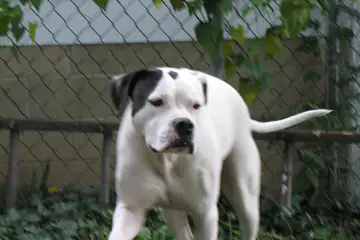
The Boxer was developed in Germany from the old Bullenbeisser hunting dogs crossed with English bulldog stock, first for holding large game and later as a police and military dog. A Boxer is a clean limbed, square built dog with a short glossy coat, an undershot jaw and a blunt muzzle. Boxers stay puppyish for years: exuberant, clownish, physical in their play, and generally patient with children in their own family where there is supervision and early socialisation.
The breed needs a great deal of daily exercise on lead or in secure fencing, and a young Boxer jumps at everything, so teaching four feet on the floor starts early. Grooming is a going over with a rubber curry brush or hound glove once or twice a week. The flat face and thin coat mean they cope badly with both heat and cold, so they live indoors. Owners often read the bouncing and leaping as bad behaviour when it is unspent energy.
What to expect at eight weeks
At eight weeks a Boxer puppy is sleeping around 18 to 20 hours a day, is not house trained, and cannot hold on for more than an hour or two at a stretch. A large breed puppy at eight weeks looks deceptively normal sized and will roughly double every few weeks for a while. Keep exercise short and low impact, the growth plates are wide open. This is a high energy breed. At eight weeks that shows up as intensity rather than stamina, and they will need a job to do long before they need long walks. Grooming needs are moderate, so build the brushing habit now while the coat is still short and easy. The socialisation window is open and closing: everything they meet calmly now, from vacuum cleaners to men in hats, is easier for the rest of their life.
Health worth knowing about
Conditions this breed is reported to be predisposed to. Predisposed does not mean inevitable, it means ask about it.
- Hip dysplasia, which breeding stock should be hip scored by x-ray before mating
- Elbow dysplasia, which breeding stock should be elbow graded by x-ray before mating
- Hereditary eye disease screened under the BVA/KC/ISDS Eye Scheme
- Breathing difficulty linked to the flat face (brachycephaly), graded by a vet on an exercise tolerance test
Your Boxer puppy's first six months
- Vaccination schedule, dated for your country.
- Worming and parasite schedule.
- Feeding calculator. Set expected adult size to Large for a Boxer.
- Adult size predictor, to check growth against the 22.7 to 36.3 kg adult range.
- Puppy names and the first week checklist.
Kit sizes: crate 42 inch (42 x 28 x 30 in, 107 x 71 x 76 cm) for an adult of up to 36.3 kg; chew toys made for large breeds. Worked out the same way as the crate size calculator. PetMD bases a crate on the dog's own measurements, not weight or breed alone, so measure once the puppy is home.
Buying guides for this
Other large breeds

More on the Boxer
Previous: Boxador · Next: Boxerdoodle
Not veterinary advice. Breed information is general. Your own dog, and your own vet, always win.
Sources
- akc.org for adult weight and height, life expectancy, energy, grooming, shedding and the temperament ratings, coat type and health notes
- fci.be for country of origin
- Health notes from Boxer breed information at https://www.akc.org/dog-breeds/boxer/. Discuss any of these with your own vet.
Photo: Mood210, CC BY-SA 3.0, via Wikimedia Commons, cropped. All photographers are listed on the photo credits page.