Breeds / Medium
Puli puppies
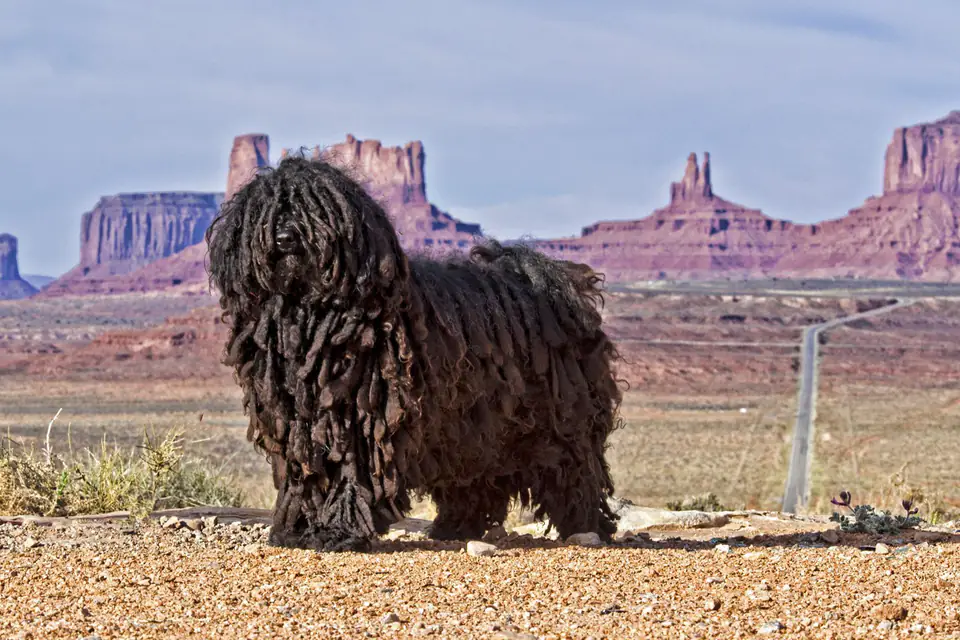
Lively, clever and self assured, a corded Hungarian herder that is loyal to their own family, watchful with strangers and rarely still.
The facts
- Size class Medium
- Country of origin Hungary
- Adult weight 11.3 to 15.9 kg
- Adult weight in pounds 25 to 35 lb
- Adult height 41 to 43 cm
- Energy level Moderate
- Grooming High
- Coat type Long corded and double
- Shedding Low
- Typical lifespan 10 to 15 years
- Good with children Fine with supervision
- Good with other dogs Fine with supervision
About the Puli
The Puli is a Hungarian herding dog whose corded coat is the first thing anyone notices. The cords form naturally as the undercoat comes in and tangles with the outer coat, and they gave the dog protection from weather and from livestock out on the plains. Adults weigh 11.3 to 15.9 kg and stand 41 to 43 cm, living 10 to 15 years. Under the coat is a springy, agile dog that bounces rather than walks, sharp minded, devoted to their family and quick to notice a stranger.
The cords have to be separated by hand as they form, after which the routine is bathing and a long drying time. Some owners clip instead. The Puli sheds very little, so loose hair stays in the coat. Exercise should be daily and mental as well as physical, with care not to overdo it while a puppy is still growing. Pulik are vocal and make sharp watchdogs. Give the coat extra attention during the year it is turning into cords.
What to expect at eight weeks
At eight weeks a Puli puppy is sleeping around 18 to 20 hours a day, is not house trained, and cannot hold on for more than an hour or two at a stretch. A medium breed puppy at eight weeks is a manageable armful that will not stay that way. Most of the growth happens between now and six months, so buy for the adult dog where you can. Expect moderate energy, in short bursts separated by long naps. Grooming needs are high. Start daily brushing and short, positive handling sessions at eight weeks, well before the adult coat arrives, or the first professional groom will be traumatic. The socialisation window is open and closing: everything they meet calmly now, from vacuum cleaners to men in hats, is easier for the rest of their life.
Health worth knowing about
Conditions this breed is reported to be predisposed to. Predisposed does not mean inevitable, it means ask about it.
- Hip dysplasia, screened by OFA or PennHIP evaluation of breeding stock
- Patellar luxation, diagnosed by physical examination of the stifle
- Degenerative myelopathy, detectable by DNA test
- Eye disorders, found by an ophthalmologist evaluation repeated every few years
- Genetic deafness, detectable by BAER testing
Your Puli puppy's first six months
- Vaccination schedule, dated for your country.
- Worming and parasite schedule.
- Feeding calculator. Set expected adult size to Medium for a Puli.
- Adult size predictor, to check growth against the 11.3 to 15.9 kg adult range.
- Puppy names and the first week checklist.
Kit sizes: crate 30 inch (30 x 20 x 23 in, 76 x 51 x 58 cm) for an adult of up to 15.9 kg; chew toys made for medium breeds. Worked out the same way as the crate size calculator. PetMD bases a crate on the dog's own measurements, not weight or breed alone, so measure once the puppy is home.
Buying guides for this
Other medium breeds
 American Cocker Spaniel
 American Pit Bull Terrier
 American Staffordshire Terrier
 American Water Spaniel
 Aussiedoodle
 Australian Cattle Dog
Not veterinary advice. Breed information is general. Your own dog, and your own vet, always win.
Sources
- akc.org for adult weight and height, life expectancy, energy, grooming, shedding and the temperament ratings, coat type and health notes
- fci.be for country of origin
- Health notes from Puli breed information at https://www.akc.org/dog-breeds/puli/. Discuss any of these with your own vet.
Photo: Anita Ritenour, CC BY 2.0, via Wikimedia Commons, cropped. All photographers are listed on the photo credits page.