Breeds / Small
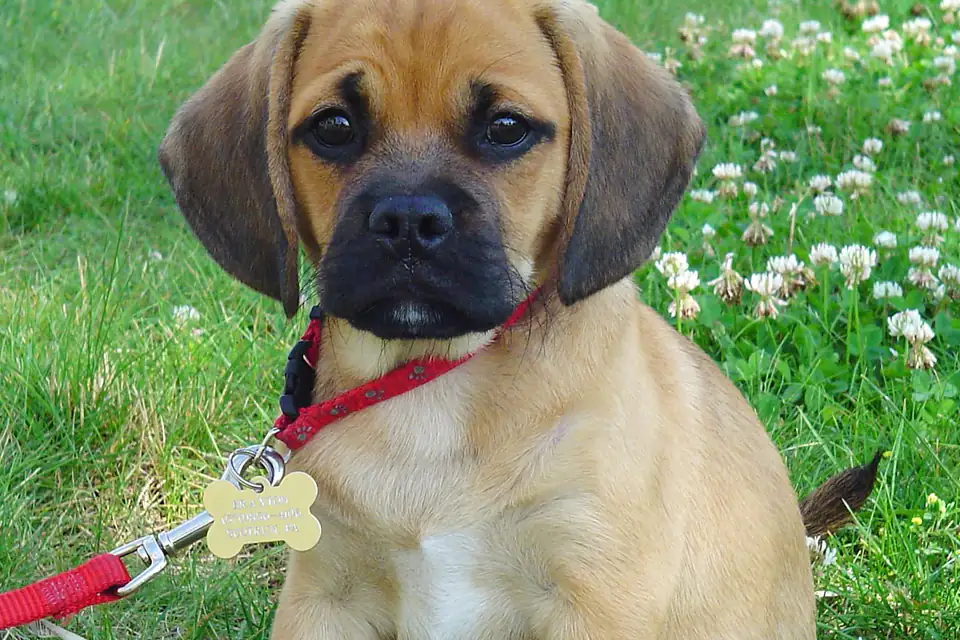
Puggle puppies
The Puggle is outgoing and playful, sociable with people of all ages and with other dogs, and affectionate once their exercise is done. They have more energy and drive than the Pug parent suggests and need daily mental and physical work.
The facts
- Size class Small
- A cross of Pug and Beagle
- Country of origin United States
- Adult weight 6.4 to 13.6 kg
- Adult weight in pounds 14 to 30 lb
- Adult height 25 to 38 cm
- Energy level High
- Grooming Low
- Coat type Short smooth
- Typical lifespan 10 to 15 years
- Good with children Reliably good
- Good with other dogs Reliably good
About the Puggle
The Puggle appeared in the United States in the 1980s, a Pug crossed with a Beagle, and this was one of the first designer crosses to sell in real numbers. Adults are 6.4 to 13.6 kg with short, low maintenance fur, and the muzzle can come out flat like the Pug's or longer like the Beagle's. They are sociable dogs, easy with strangers, children and other dogs, and they carry far more drive than the Pug parent suggests.
They need daily exercise and a nose game or two, plus a securely fenced garden, because the Beagle side follows a scent and stops listening. Grooming is a weekly brush along with wrinkle and ear cleaning. Muzzle length is the thing to check before buying: a puppy with the Pug face inherits the Pug's breathing problems, so watch both parents at rest and after exercise rather than trusting the label on the litter.
A cross, not a breed. The Puggle is a cross rather than a standardised breed, so size, muzzle length and temperament vary and can favour either parent, and a first cross of two purebred parents is less predictable than a later generation bred back to one side. Muzzle length is the one to watch: a puppy that takes after the Pug can inherit the same airway problems, so look at the parents and the puppy breathing at rest and after play.
What to expect at eight weeks
At eight weeks a Puggle puppy is sleeping around 18 to 20 hours a day, is not house trained, and cannot hold on for more than an hour or two at a stretch. A small breed puppy at eight weeks is light enough to carry everywhere, which is exactly how you get them socialised before the vaccination course finishes. They will still need four meals a day. This is a high energy breed. At eight weeks that shows up as intensity rather than stamina, and they will need a job to do long before they need long walks. Grooming is straightforward, but start handling the coat, feet and ears in week one anyway so it is never a fight later. The socialisation window is open and closing: everything they meet calmly now, from vacuum cleaners to men in hats, is easier for the rest of their life.
Health worth knowing about
Conditions this breed is reported to be predisposed to. Predisposed does not mean inevitable, it means ask about it.
- Brachycephalic obstructive airway syndrome where the flat Pug muzzle is inherited, assessed on conformation and an exercise tolerance test
- Hip dysplasia, diagnosed by imaging and screened by hip scoring radiographs
- Patellar luxation, graded on orthopaedic examination
- Chronic ear infections in the pendulous Beagle ear, found on otoscopic examination
- Autoimmune thyroiditis and hypothyroidism, diagnosed on a thyroid blood panel
- Inherited eye disease, detected by a board certified veterinary ophthalmologist examination
Your Puggle puppy's first six months
- Vaccination schedule, dated for your country.
- Worming and parasite schedule.
- Feeding calculator. Set expected adult size to Small for a Puggle.
- Adult size predictor, to check growth against the 6.4 to 13.6 kg adult range.
- Puppy names and the first week checklist.
Kit sizes: crate 30 inch (30 x 20 x 23 in, 76 x 51 x 58 cm) for an adult of up to 13.6 kg; chew toys made for small breeds. Worked out the same way as the crate size calculator. PetMD bases a crate on the dog's own measurements, not weight or breed alone, so measure once the puppy is home.
Buying guides for this
Other small breeds

More on the Puggle
Not veterinary advice. Breed information is general. Your own dog, and your own vet, always win.
Sources
- petmd.com for adult weight and height, life expectancy, energy, grooming and the temperament ratings, coat type, country of origin and health notes
- Health notes from Puggle breed information at https://www.petmd.com/dog/breeds/puggle. Discuss any of these with your own vet.
Photo: Sav127, CC BY-SA 3.0, via Wikimedia Commons, cropped. All photographers are listed on the photo credits page.