Breeds / Small
Lancashire Heeler puppies
Clever, cheeky and alert, a small English drover's dog that is happy in company and quick to speak up.
The facts
- Size class Small
- Country of origin England
- Adult weight 4.1 to 7.7 kg
- Adult weight in pounds 9 to 17 lb
- Adult height 25 to 30 cm
- Energy level High
- Grooming Low
- Coat type Short double
- Shedding Moderate
- Typical lifespan 12 to 15 years
- Good with children Reliably good
- Good with other dogs Reliably good
About the Lancashire Heeler
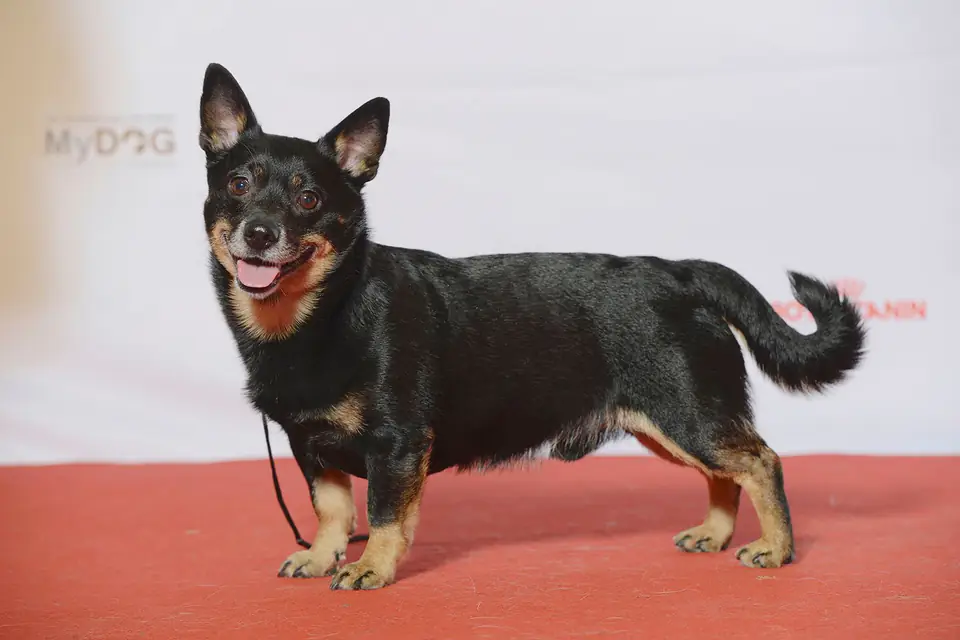
The Lancashire Heeler is a small English drover's dog, used to move cattle by nipping at their heels and to kill rats around the farm. They weigh 4.1 to 7.7 kg and stand 25 to 30 cm, black and tan, low to the ground, with a short hard waterproof coat and a habit of pulling their lips back into what owners call a heeler smile. They are clever, cheeky and endlessly interested, and they rate at the top of the scale with both children and other pets.
Energy is high for the size, so daily walks plus tricks, agility or scent work, after which they are quite happy to sit alongside you. Grooming is a light brush and an occasional bath. They bark more than most. The heel nipping they were bred for will find ankles and trouser legs unless it is redirected onto toys early, and that is the thing new owners let slide. Supervision and socialisation still apply with children. They may be small, but this is still a working herding dog, so resist treating one as a lapdog.
What to expect at eight weeks
At eight weeks a Lancashire Heeler puppy is sleeping around 18 to 20 hours a day, is not house trained, and cannot hold on for more than an hour or two at a stretch. A small breed puppy at eight weeks is light enough to carry everywhere, which is exactly how you get them socialised before the vaccination course finishes. They will still need four meals a day. This is a high energy breed. At eight weeks that shows up as intensity rather than stamina, and they will need a job to do long before they need long walks. Grooming is straightforward, but start handling the coat, feet and ears in week one anyway so it is never a fight later. The socialisation window is open and closing: everything they meet calmly now, from vacuum cleaners to men in hats, is easier for the rest of their life.
Health worth knowing about
Conditions this breed is reported to be predisposed to. Predisposed does not mean inevitable, it means ask about it.
- Primary lens luxation, detectable by DNA test
- Collie eye anomaly, detectable by DNA test and by eye examination in puppies
- Persistent pupillary membranes, found at an ophthalmologist eye examination
- Patellar luxation, detected on orthopaedic examination
Your Lancashire Heeler puppy's first six months
- Vaccination schedule, dated for your country.
- Worming and parasite schedule.
- Feeding calculator. Set expected adult size to Small for a Lancashire Heeler.
- Adult size predictor, to check growth against the 4.1 to 7.7 kg adult range.
- Puppy names and the first week checklist.
Kit sizes: crate 24 inch (24 x 18 x 20 in, 61 x 46 x 51 cm) for an adult of up to 7.7 kg; chew toys made for small breeds. Worked out the same way as the crate size calculator. PetMD bases a crate on the dog's own measurements, not weight or breed alone, so measure once the puppy is home.
Buying guides for this
Other small breeds

More on the Lancashire Heeler
Previous: Lakeland Terrier · Next: Landseer (European Continental Type)
Not veterinary advice. Breed information is general. Your own dog, and your own vet, always win.
Sources
- akc.org for adult weight and height, life expectancy, energy, grooming, shedding and the temperament ratings, coat type and health notes
- fci.be for country of origin
- Health notes from Lancashire Heeler breed information at https://www.akc.org/dog-breeds/lancashire-heeler/. Discuss any of these with your own vet.
Photo: Svenska Mässan from Sweden, CC BY 2.0, via Wikimedia Commons, cropped. All photographers are listed on the photo credits page.