Breeds / Medium
Irish Terrier puppies
The Irish Terrier is a racy red Irish terrier, bold and devoted to their own family but often intolerant of other dogs and small animals. They are smart, headstrong and need firm, positive training and secure fencing.

The facts
- Size class Medium
- Country of origin Ireland
- Adult weight 11.3 to 12.2 kg
- Adult weight in pounds 25 to 27 lb
- Adult height 46 cm
- Energy level Moderate
- Grooming Low
- Coat type Medium double and wiry
- Shedding Low
- Typical lifespan 13 to 15 years
- Good with children Reliably good
- Good with other dogs Not recommended
About the Irish Terrier
The Irish Terrier is one of the oldest of the terrier breeds, an all round Irish farm dog that killed vermin, guarded the house and carried messages under fire in the First World War. This is a racy, long legged terrier of about 46 cm in a dense wiry red jacket over a softer undercoat, with a long head and a bold, forward expression. With their own family they are affectionate and openly devoted, rated 5 out of 5 with children given supervision and early socialisation.
Energy is moderate but the dog needs a job, so training, earthdog work or agility all help. The coat is hand stripped rather than clipped, with weekly brushing in between, and it sheds very little. The point new owners must plan around is the rating of 1 out of 5 with other pets: this breed is genuinely quarrelsome with other dogs and lethal with small animals. Secure fencing and lead walks are the answer. Friendly at home is no guarantee of friendly at the dog park, so never take it for granted.
What to expect at eight weeks
At eight weeks a Irish Terrier puppy is sleeping around 18 to 20 hours a day, is not house trained, and cannot hold on for more than an hour or two at a stretch. A medium breed puppy at eight weeks is a manageable armful that will not stay that way. Most of the growth happens between now and six months, so buy for the adult dog where you can. Expect moderate energy, in short bursts separated by long naps. Grooming is straightforward, but start handling the coat, feet and ears in week one anyway so it is never a fight later. The socialisation window is open and closing: everything they meet calmly now, from vacuum cleaners to men in hats, is easier for the rest of their life.
Health worth knowing about
Conditions this breed is reported to be predisposed to. Predisposed does not mean inevitable, it means ask about it.
- Hyperkeratosis of the footpads, detectable by DNA test on both parents
- Cystinuria, which causes bladder stones and is picked up by urine testing and imaging
- Hypothyroidism, detected by a blood test of thyroid hormone levels
Your Irish Terrier puppy's first six months
- Vaccination schedule, dated for your country.
- Worming and parasite schedule.
- Feeding calculator. Set expected adult size to Medium for a Irish Terrier.
- Adult size predictor, to check growth against the 11.3 to 12.2 kg adult range.
- Puppy names and the first week checklist.
Kit sizes: crate 30 inch (30 x 20 x 23 in, 76 x 51 x 58 cm) for an adult of up to 12.2 kg; chew toys made for medium breeds. Worked out the same way as the crate size calculator. PetMD bases a crate on the dog's own measurements, not weight or breed alone, so measure once the puppy is home.
Buying guides for this
Other medium breeds
 American Cocker Spaniel
 American Pit Bull Terrier
 American Staffordshire Terrier
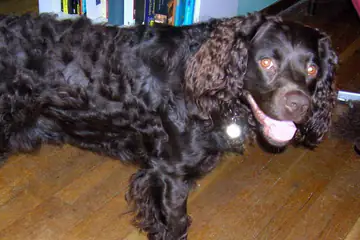 American Water Spaniel
 Aussiedoodle
 Australian Cattle Dog
More on the Irish Terrier
Previous: Irish Setter · Next: Irish Water Spaniel
Not veterinary advice. Breed information is general. Your own dog, and your own vet, always win.
Sources
- akc.org for adult weight and height, life expectancy, energy, grooming, shedding and the temperament ratings, coat type and health notes
- fci.be for country of origin
- Health notes from Irish Terrier breed information at https://www.akc.org/dog-breeds/irish-terrier/. Discuss any of these with your own vet.
Photo: Goldmull, CC BY-SA 4.0, via Wikimedia Commons, cropped. All photographers are listed on the photo credits page.