Breeds / Large
Irish Setter puppies
Demonstrably affectionate, refined in looks and tremendously active, with an untiring readiness to range and hunt under any conditions. Sociable with people but often too boisterous for small children.
The facts
- Size class Large
- Country of origin Ireland
- Adult weight 27.2 to 31.8 kg
- Adult weight in pounds 60 to 70 lb
- Adult height 64 to 69 cm
- Energy level Very high
- Grooming Moderate
- Coat type Medium silky
- Shedding Moderate
- Typical lifespan 12 to 15 years
- Good with children Reliably good
- Good with other dogs Reliably good
About the Irish Setter
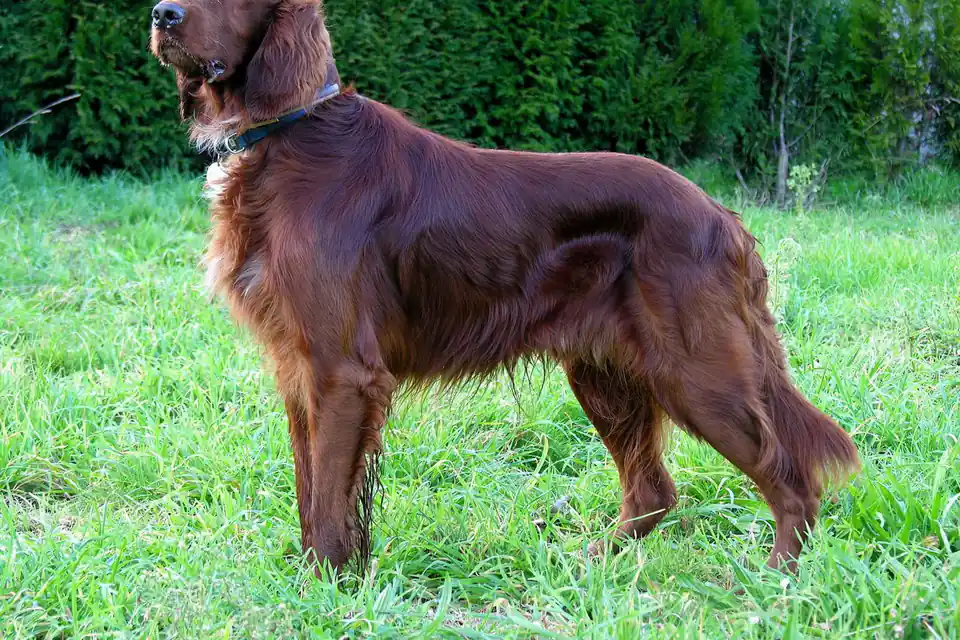
The Irish Setter is the tall chestnut red gundog of Ireland, bred to range wide across open ground, find birds and hold a point for a walking gun. They stand 64 to 69 cm and weigh 27.2 to 31.8 kg, with a silky coat, long ear and leg feathering and a light, driving stride. The temperament is exuberant and openly affectionate, rated 5 out of 5 with children and other pets, though the sheer bounce of the breed means small children need supervision rather than a promise.
These are very high energy dogs. Long daily exercise and training are both non negotiable, and canine sport helps burn off a busy mind. Brush at least twice a week with a pin brush and comb out the feathering before it mats. Because the breed is deep chested, learn the signs of bloat and keep hard exercise away from mealtimes. Irish Setters stay adolescent for years. That slow maturity has nothing to do with stupidity, so stick with training and do not give up too early.
What to expect at eight weeks
At eight weeks a Irish Setter puppy is sleeping around 18 to 20 hours a day, is not house trained, and cannot hold on for more than an hour or two at a stretch. A large breed puppy at eight weeks looks deceptively normal sized and will roughly double every few weeks for a while. Keep exercise short and low impact, the growth plates are wide open. This is a very high energy breed. The mistake owners make is trying to tire them out physically. Training, scentwork and puzzles will do more than distance ever will. Grooming needs are moderate, so build the brushing habit now while the coat is still short and easy. The socialisation window is open and closing: everything they meet calmly now, from vacuum cleaners to men in hats, is easier for the rest of their life.
Health worth knowing about
Conditions this breed is reported to be predisposed to. Predisposed does not mean inevitable, it means ask about it.
- Progressive retinal atrophy (PRA rcd4), detectable by DNA test
- Progressive retinal atrophy (PRA rcd1), detectable by DNA test
- Canine leukocyte adhesion deficiency (CLAD), detectable by DNA test
- Hip dysplasia, screened under the BVA/KC Hip Dysplasia Scheme
- Elbow dysplasia, screened under the BVA/KC Elbow Dysplasia Scheme
- Inherited eye disease, screened under the BVA/KC/ISDS Eye Scheme
Your Irish Setter puppy's first six months
- Vaccination schedule, dated for your country.
- Worming and parasite schedule.
- Feeding calculator. Set expected adult size to Large for a Irish Setter.
- Adult size predictor, to check growth against the 27.2 to 31.8 kg adult range.
- Puppy names and the first week checklist.
Kit sizes: crate 36 inch (36 x 24 x 26 in, 91 x 61 x 66 cm) for an adult of up to 31.8 kg; chew toys made for large breeds. Worked out the same way as the crate size calculator. PetMD bases a crate on the dog's own measurements, not weight or breed alone, so measure once the puppy is home.
Buying guides for this
Other large breeds





More on the Irish Setter
Previous: Irish Red and White Setter · Next: Irish Terrier
Not veterinary advice. Breed information is general. Your own dog, and your own vet, always win.
Sources
- akc.org for adult weight and height, life expectancy, energy, grooming, shedding and the temperament ratings, coat type and health notes
- fci.be for country of origin
- Health notes from Irish Setter breed information at https://www.akc.org/dog-breeds/irish-setter/. Discuss any of these with your own vet.
Photo: Luis Miguel Bugallo Sánchez (Lmbuga), CC BY-SA 3.0, via Wikimedia Commons, cropped. All photographers are listed on the photo credits page.