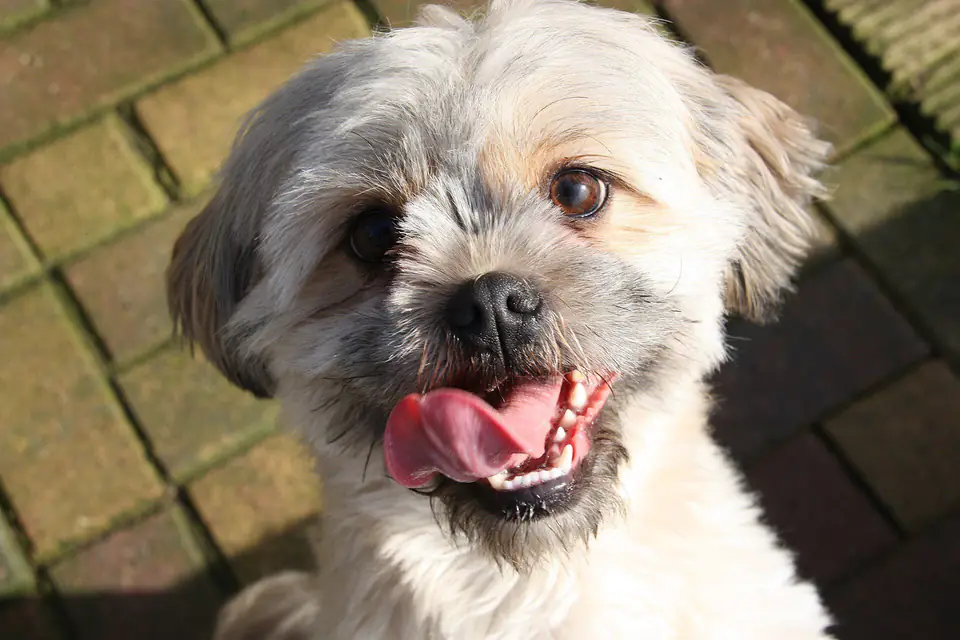
The facts
- Size class Small
- Country of origin Tibet (China)
- Adult weight 4.1 to 7.3 kg
- Adult weight in pounds 9 to 16 lb
- Adult height 23 to 27 cm
- Energy level Moderate
- Grooming High
- Coat type Long double
- Shedding Low
- Typical lifespan 10 to 18 years
- Good with children Reliably good
- Good with other dogs Reliably good
About the Shih Tzu
The Shih Tzu was bred in Tibet and developed further in the Chinese imperial court as a house companion, with no working job beyond sitting with people, which is still what they are best at. They weigh 4.1 to 7.3 kg and stand 23 to 27 cm, solidly built under a long double coat, with a short face and a distinctly upward looking expression. They are friendly and cheerful without being clingy, and they are rated five out of five with children and with other pets.
Exercise needs are small: short daily walks and indoor play satisfy them. Grooming is the opposite, with daily brushing right down to the skin on a full coat, the moustache and topknot combed out, and the head hair trimmed or tied up so it does not irritate the eyes. A clip is a fair option if that is too much. The short face means they cope badly with heat and swim poorly. Supervision and socialisation still apply with young children, and neglected coats mat painfully.
What to expect at eight weeks
At eight weeks a Shih Tzu puppy is sleeping around 18 to 20 hours a day, is not house trained, and cannot hold on for more than an hour or two at a stretch. A small breed puppy at eight weeks is light enough to carry everywhere, which is exactly how you get them socialised before the vaccination course finishes. They will still need four meals a day. Expect moderate energy, in short bursts separated by long naps. Grooming needs are high. Start daily brushing and short, positive handling sessions at eight weeks, well before the adult coat arrives, or the first professional groom will be traumatic. The socialisation window is open and closing: everything they meet calmly now, from vacuum cleaners to men in hats, is easier for the rest of their life.
Health worth knowing about
Conditions this breed is reported to be predisposed to. Predisposed does not mean inevitable, it means ask about it.
- Brachycephalic obstructive airway syndrome (BOAS), graded by a vet on an exercise tolerance test
- Hereditary eye disease screened under the BVA/KC/ISDS Eye Scheme
- Skin problems in the facial folds, found on a routine veterinary skin check and kept down by daily fold cleaning
- Dental crowding and periodontal disease, found at a routine dental check and kept down by regular teeth cleaning
Your Shih Tzu puppy's first six months
- Vaccination schedule, dated for your country.
- Worming and parasite schedule.
- Feeding calculator. Set expected adult size to Small for a Shih Tzu.
- Adult size predictor, to check growth against the 4.1 to 7.3 kg adult range.
- Puppy names and the first week checklist.
Kit sizes: crate 24 inch (24 x 18 x 20 in, 61 x 46 x 51 cm) for an adult of up to 7.3 kg; chew toys made for small breeds. Worked out the same way as the crate size calculator. PetMD bases a crate on the dog's own measurements, not weight or breed alone, so measure once the puppy is home.
Buying guides for this
Other small breeds

More on the Shih Tzu
Previous: Shiba Inu · Next: Shih-Poo
Not veterinary advice. Breed information is general. Your own dog, and your own vet, always win.
Sources
- akc.org for adult weight and height, life expectancy, energy, grooming, shedding and the temperament ratings, coat type and health notes
- fci.be for country of origin
- Health notes from Shih Tzu breed information at https://www.akc.org/dog-breeds/shih-tzu/. Discuss any of these with your own vet.
Photo: Lars Curfs ( Grashoofd ), CC BY-SA 3.0, via Wikimedia Commons, cropped. All photographers are listed on the photo credits page.