Breeds / Medium
Pomsky puppies
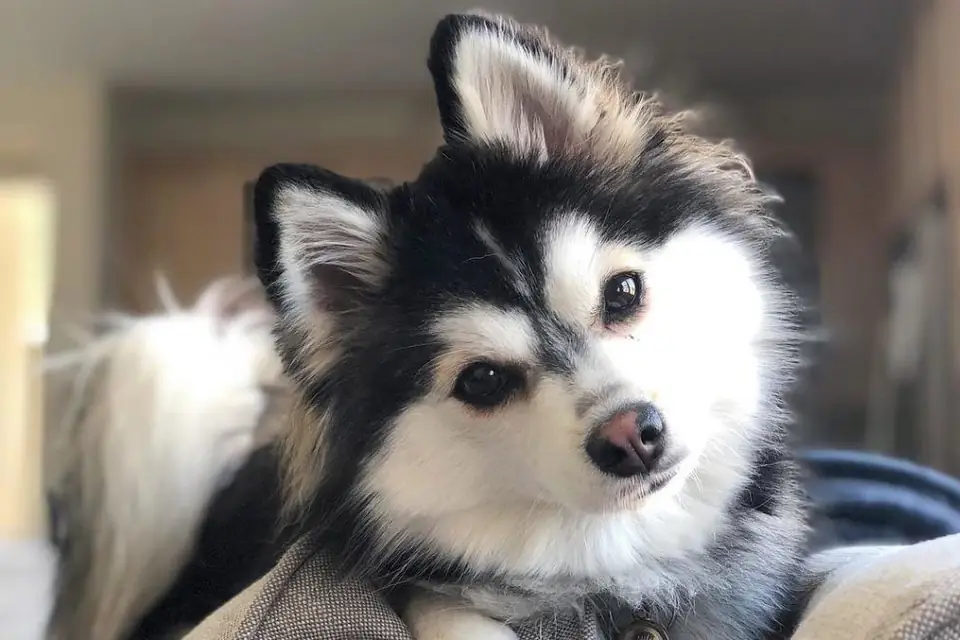
The Pomsky is intelligent, spunky and strongly attached to their owner, friendly with people and other dogs but often needing supervised introductions to cats. Boredom is the usual cause of behaviour problems, so early training and daily mental work matter.
The facts
- Size class Medium
- A cross of Pomeranian and Siberian Husky
- Country of origin United States
- Adult weight 5.4 to 15.9 kg
- Adult weight in pounds 12 to 35 lb
- Adult height 30 to 46 cm
- Energy level High
- Grooming Moderate
- Coat type Medium double
- Typical lifespan 12 to 15 years
- Good with children Fine with supervision
- Good with other dogs Fine with supervision
About the Pomsky
The Pomsky is a Pomeranian crossed with a Siberian Husky, a pairing that has only existed since 2012 and that has to be produced by artificial insemination because of the size difference. Adults are 5.4 to 15.9 kg and 30 to 46 cm, so the finished dog is far smaller than the Husky parent. Coats come as standard, plush or wooly, and all of them shed. The character is confident, spirited and closely bonded to one person.
Two or three brushings a week is normal, with much heavier work during the spring and autumn moults. Exercise matters, and training matters more, because a bright and opinionated dog with nothing to do finds their own entertainment by digging, escaping or shouting. Introductions to cats and other small pets should be slow and supervised. If it is the Husky look you love, do not expect a lap dog underneath it.
A cross, not a breed. The Pomsky is a cross rather than a standardised breed, so size, coat and temperament vary and can favour either parent, and a first cross of two purebred parents is less predictable than a later generation bred back to one side. Toy, mini and standard types are advertised, and the coat can be standard, plush or wooly, which changes how much brushing and seasonal de-shedding it needs.
What to expect at eight weeks
At eight weeks a Pomsky puppy is sleeping around 18 to 20 hours a day, is not house trained, and cannot hold on for more than an hour or two at a stretch. A medium breed puppy at eight weeks is a manageable armful that will not stay that way. Most of the growth happens between now and six months, so buy for the adult dog where you can. This is a high energy breed. At eight weeks that shows up as intensity rather than stamina, and they will need a job to do long before they need long walks. Grooming needs are moderate, so build the brushing habit now while the coat is still short and easy. The socialisation window is open and closing: everything they meet calmly now, from vacuum cleaners to men in hats, is easier for the rest of their life.
Health worth knowing about
Conditions this breed is reported to be predisposed to. Predisposed does not mean inevitable, it means ask about it.
- Patellar luxation, graded on orthopaedic examination
- Hip dysplasia, screened by physical examination and hip scoring radiographs
- Inherited eye disease including juvenile cataracts, progressive retinal atrophy and corneal dystrophy, detected by annual eye examination and by DNA test
- Collapsing trachea from the Pomeranian side, recognised by a honking cough and confirmed on radiographs or fluoroscopy
- Dental disease and early tooth loss in the small jaw, found at annual dental checks
- Atopic skin allergies, diagnosed by excluding other causes and by allergy testing
Your Pomsky puppy's first six months
- Vaccination schedule, dated for your country.
- Worming and parasite schedule.
- Feeding calculator. Set expected adult size to Medium for a Pomsky.
- Adult size predictor, to check growth against the 5.4 to 15.9 kg adult range.
- Puppy names and the first week checklist.
Kit sizes: crate 30 inch (30 x 20 x 23 in, 76 x 51 x 58 cm) for an adult of up to 15.9 kg; chew toys made for medium breeds. Worked out the same way as the crate size calculator. PetMD bases a crate on the dog's own measurements, not weight or breed alone, so measure once the puppy is home.
Buying guides for this
Other medium breeds
 American Cocker Spaniel
 American Pit Bull Terrier
 American Staffordshire Terrier
 American Water Spaniel
 Aussiedoodle
 Australian Cattle Dog
Previous: Pomeranian · Next: Pont-Audemer Spaniel
Not veterinary advice. Breed information is general. Your own dog, and your own vet, always win.
Sources
- petmd.com for adult weight and height, life expectancy, energy, grooming and the temperament ratings, coat type and health notes
- purina.co.uk for country of origin
- Health notes from Pomsky breed information at https://www.petmd.com/dog/breeds/pomsky. Discuss any of these with your own vet.
Photo: Paulconwall, CC BY-SA 4.0, via Wikimedia Commons, cropped. All photographers are listed on the photo credits page.