Breeds / Size not published
Old Danish Pointer puppies
Calm, steady and affectionate, a Danish gundog that works close and methodically in the field and settles easily at home.
The facts
- Size class Not published
- Country of origin Denmark
- Adult weight Not published
- Adult weight in pounds Not published
- Adult height Not published
- Energy level Moderate
- Grooming Low
- Coat type Not published
- Shedding Moderate
- Typical lifespan Not published
- Good with children Reliably good
- Good with other dogs Reliably good
About the Old Danish Pointer
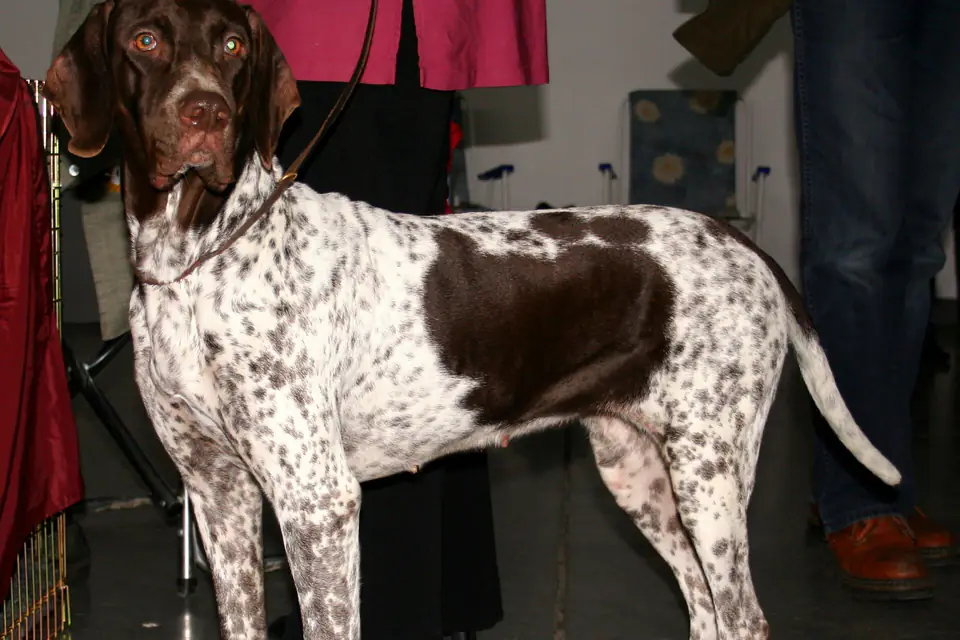
The Old Danish Pointer was developed in Denmark in the eighteenth century, crossing local farm dogs with pointers brought in by travelling breeders, to produce a steady gundog that worked close to a hunter on foot. This is a solid, powerfully built pointer with a short dense coat, white with brown markings, and a broad heavy head. The temperament matches the working style: unhurried, even tempered, affectionate at home, and easy going with people and other dogs rather than nervy and driven.
Exercise needs are moderate for a gundog. Long walks, field work or scent games satisfy them, and they settle well afterwards. Grooming is minimal, a weekly brush to manage shedding plus nails, ears and the occasional bath. Training is straightforward with a soft approach, since the breed is willing without being pushy. They rate highly with children and other pets, given supervision and early socialisation. Just make sure that nose has work to do, because a pointer with nothing to find will invent their own search.
What to expect at eight weeks
At eight weeks a Old Danish Pointer puppy is sleeping around 18 to 20 hours a day, is not house trained, and cannot hold on for more than an hour or two at a stretch. Expect moderate energy, in short bursts separated by long naps. Grooming is straightforward, but start handling the coat, feet and ears in week one anyway so it is never a fight later. The socialisation window is open and closing: everything they meet calmly now, from vacuum cleaners to men in hats, is easier for the rest of their life.
Health worth knowing about
Conditions this breed is reported to be predisposed to. Predisposed does not mean inevitable, it means ask about it.
- Hip dysplasia, which breeding stock should be x-rayed and scored for
- Progressive retinal atrophy, detectable by DNA test and eye screening
- Ear infections in the drop ears, found by regular checking and cleaning
Your Old Danish Pointer puppy's first six months
- Vaccination schedule, dated for your country.
- Worming and parasite schedule.
- Feeding calculator.
- Adult size predictor, to check growth against the Not published adult range.
- Puppy names and the first week checklist.
Buying guides for this
More on the Old Danish Pointer
Previous: Nova Scotia Duck Tolling Retriever · Next: Old English Sheepdog
Not veterinary advice. Breed information is general. Your own dog, and your own vet, always win.
Sources
- akc.org for adult weight and height, life expectancy, energy, grooming, shedding and the temperament ratings, coat type and health notes
- fci.be for country of origin
- Health notes from Old Danish Pointer breed information at https://www.akc.org/dog-breeds/old-danish-pointer/. Discuss any of these with your own vet.
No published figure for adult weight, adult height, life expectancy and coat type, so nothing is shown rather than a guess.
Photo: Pleple2000, CC BY-SA 3.0, via Wikimedia Commons, cropped. All photographers are listed on the photo credits page.