Breeds / Large
Labradoodle puppies
Friendly, loyal and quick to learn, the Labradoodle is an active family companion that was first bred as an assistance dog. They are sociable to the point of disliking long spells alone, and need about an hour of exercise a day.
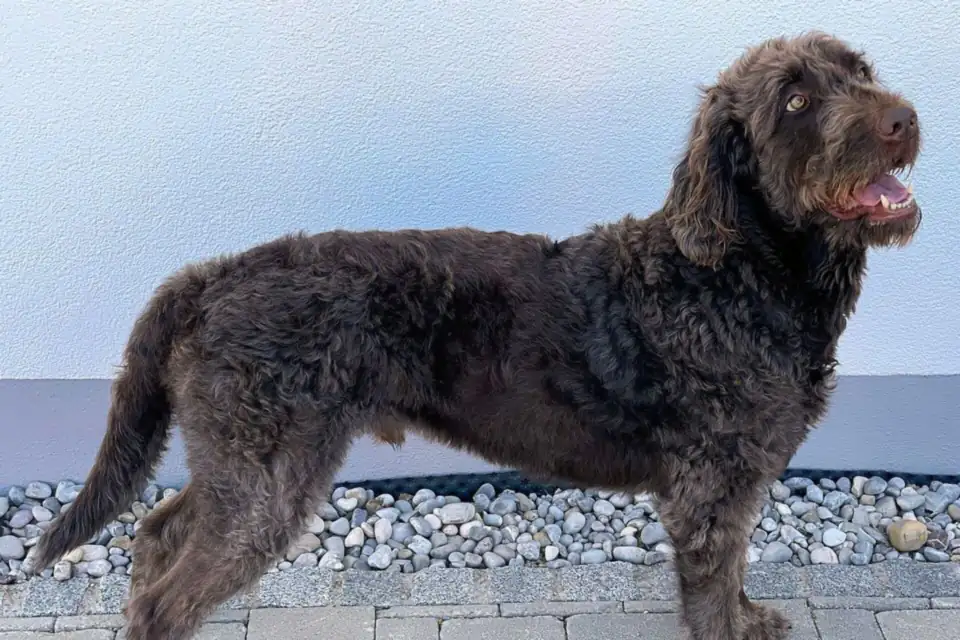
The facts
- Size class Large
- A cross of Labrador Retriever and Poodle
- Country of origin Australia
- Adult weight 22.7 to 34 kg
- Adult weight in pounds 50 to 75 lb
- Adult height 53 to 64 cm
- Energy level High
- Grooming High
- Coat type Medium wavy to curly
- Typical lifespan 12 to 15 years
- Good with children Reliably good
- Good with other dogs Reliably good
About the Labradoodle
The Labradoodle began in Australia as an attempt to produce a guide dog that shed less, crossing the Labrador Retriever with the Poodle. The result is a sturdy, athletic animal standing 53 to 64 cm, carrying a coat that can be tightly curled, loosely waved or somewhere between the two. Temperament follows the original working brief: sociable, quick to learn, and keen to be included in whatever the household happens to be doing.
Plan on about an hour of exercise a day plus training or scentwork to occupy the brain. The coat is the real commitment, with brushing at least twice a week and a professional trim every couple of months, more often on the friction points behind the ears and under the legs. Love the coat by all means, just do not let it be the only reason you buy one. A Labradoodle left by themselves all day gets loud and destructive whatever their hair is doing.
A cross, not a breed. The Labradoodle is a cross rather than a standardised breed, so size, coat and temperament vary between litters and individual puppies and can favour either parent, and it matters whether a puppy is a first cross of two purebred parents or a later generation such as a backcross to a Poodle, which is more likely to inherit the low shedding coat. A miniature Labradoodle bred from a Miniature Poodle usually finishes near 14 kg and 41 to 51 cm rather than the standard figures given here.
What to expect at eight weeks
At eight weeks a Labradoodle puppy is sleeping around 18 to 20 hours a day, is not house trained, and cannot hold on for more than an hour or two at a stretch. A large breed puppy at eight weeks looks deceptively normal sized and will roughly double every few weeks for a while. Keep exercise short and low impact, the growth plates are wide open. This is a high energy breed. At eight weeks that shows up as intensity rather than stamina, and they will need a job to do long before they need long walks. Grooming needs are high. Start daily brushing and short, positive handling sessions at eight weeks, well before the adult coat arrives, or the first professional groom will be traumatic. The socialisation window is open and closing: everything they meet calmly now, from vacuum cleaners to men in hats, is easier for the rest of their life.
Health worth knowing about
Conditions this breed is reported to be predisposed to. Predisposed does not mean inevitable, it means ask about it.
- Hip and elbow dysplasia, screened in breeding stock by OFA or PennHIP radiographs
- Progressive retinal atrophy, detectable by DNA test on both parents and by veterinary eye examination
- Hereditary cataracts and glaucoma, found on an eye examination including intraocular pressure testing
- Exercise induced collapse from the Labrador side, detectable by DNA test
- Heart disease, investigated by auscultation for a murmur, then echocardiography and chest radiographs
- Ear infections in the drop, hairy ear canal, found on otoscopic examination
Your Labradoodle puppy's first six months
- Vaccination schedule, dated for your country.
- Worming and parasite schedule.
- Feeding calculator. Set expected adult size to Large for a Labradoodle.
- Adult size predictor, to check growth against the 22.7 to 34 kg adult range.
- Puppy names and the first week checklist.
Kit sizes: crate 42 inch (42 x 28 x 30 in, 107 x 71 x 76 cm) for an adult of up to 34 kg; chew toys made for large breeds. Worked out the same way as the crate size calculator. PetMD bases a crate on the dog's own measurements, not weight or breed alone, so measure once the puppy is home.
Buying guides for this
Other large breeds

More on the Labradoodle
Previous: Kuvasz · Next: Labrador Retriever
Not veterinary advice. Breed information is general. Your own dog, and your own vet, always win.
Sources
- petmd.com for adult weight and height, life expectancy, energy, grooming and the temperament ratings, coat type and health notes
- purina.co.uk for country of origin
- Health notes from Labradoodle breed information at https://www.petmd.com/dog/breeds/labradoodle. Discuss any of these with your own vet.
Photo: Anton Porsche, CC BY-SA 4.0, via Wikimedia Commons, cropped. All photographers are listed on the photo credits page.