Breeds / Large
Komondor puppies
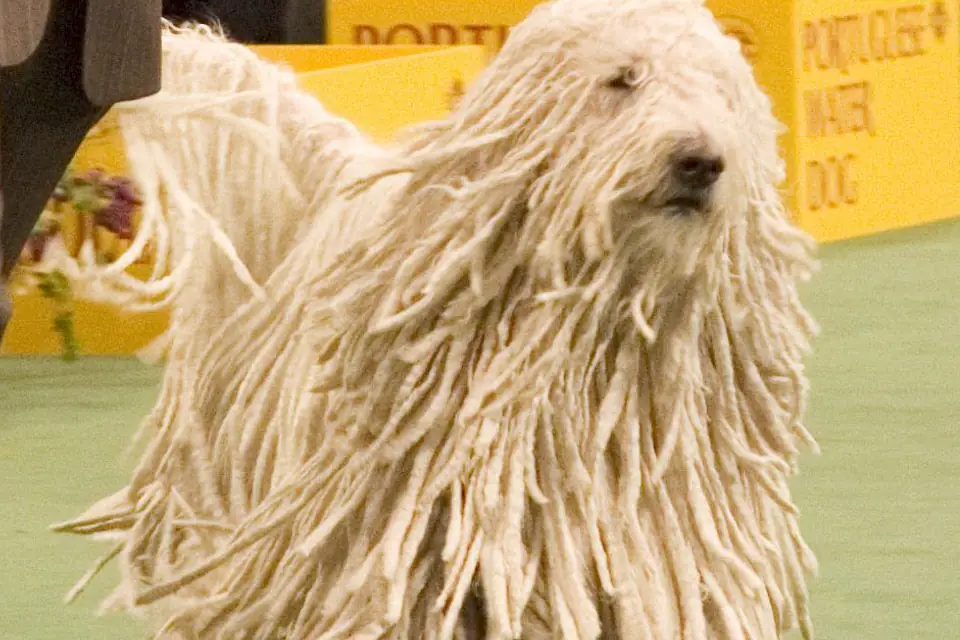
Calm with their own people and deeply suspicious of strangers. A Hungarian livestock guardian bred to make their own decisions, wearing a heavy white corded coat.
The facts
- Size class Large
- Country of origin Hungary
- Adult weight 36.3 to 45.4 kg
- Adult weight in pounds 80 to 100 lb
- Adult height 65 to 70 cm
- Energy level Moderate
- Grooming High
- Coat type Long corded
- Shedding Low
- Typical lifespan 10 to 12 years
- Good with children Fine with supervision
- Good with other dogs Careful introductions
About the Komondor
The Komondor is a Hungarian livestock guardian, a white dog whose corded coat let them live out with the flock, shed the weather and take the worst of a fight with a predator. They stand 65 to 70 cm and weigh 36.3 to 45.4 kg. They are calm and undemonstrative around their own people and deeply suspicious of anything unfamiliar, and they were bred to make their own decisions on a dark hillside without a handler telling them what to do.
The coat is the commitment. It is never brushed: the clumps are split by hand from around nine or ten months, then washed and, critically, dried right through, because a coat left damp will start to smell. Exercise is daily walks and free running in a large, securely fenced space. Dog parks are a poor idea, since a group of loose dogs reads as a threat. They rate middling with children and low with other pets, so supervise. Expecting quick, cheerful obedience from a guardian is the usual disappointment.
What to expect at eight weeks
At eight weeks a Komondor puppy is sleeping around 18 to 20 hours a day, is not house trained, and cannot hold on for more than an hour or two at a stretch. A large breed puppy at eight weeks looks deceptively normal sized and will roughly double every few weeks for a while. Keep exercise short and low impact, the growth plates are wide open. Expect moderate energy, in short bursts separated by long naps. Grooming needs are high. Start daily brushing and short, positive handling sessions at eight weeks, well before the adult coat arrives, or the first professional groom will be traumatic. The socialisation window is open and closing: everything they meet calmly now, from vacuum cleaners to men in hats, is easier for the rest of their life.
Health worth knowing about
Conditions this breed is reported to be predisposed to. Predisposed does not mean inevitable, it means ask about it.
- Hip dysplasia, certified free by OFA x-ray evaluation of breeding stock
- Inherited eye disease, screened by an ophthalmologist examination, which the parent club asks breeders for
- Bloat and gastric torsion, a sudden surgical emergency that owners need to recognise fast
- Skin infections and hot spots under the cords, found by parting the coat to the skin and checking after every bath
Your Komondor puppy's first six months
- Vaccination schedule, dated for your country.
- Worming and parasite schedule.
- Feeding calculator. Set expected adult size to Large for a Komondor.
- Adult size predictor, to check growth against the 36.3 to 45.4 kg adult range.
- Puppy names and the first week checklist.
Kit sizes: crate 48 inch (48 x 30 x 32 in, 122 x 76 x 81 cm) for an adult of up to 45.4 kg; chew toys made for large breeds. Worked out the same way as the crate size calculator. PetMD bases a crate on the dog's own measurements, not weight or breed alone, so measure once the puppy is home.
Buying guides for this
Other large breeds

Previous: Kishu Ken · Next: Koolie
Not veterinary advice. Breed information is general. Your own dog, and your own vet, always win.
Sources
- akc.org for adult weight and height, life expectancy, energy, grooming, shedding and the temperament ratings, coat type and health notes
- fci.be for country of origin
- Health notes from Komondor breed information at https://www.akc.org/dog-breeds/komondor/. Discuss any of these with your own vet.
Photo: whartonds (Flickr), cropped by Pharaoh Hound, CC BY-SA 2.5, via Wikimedia Commons, cropped. All photographers are listed on the photo credits page.