Breeds / Large
Drentsche Patrijshond puppies
Loyal, sensitive and quietly biddable, the Drentsche Patrijshond is a versatile Dutch gundog that is unusually gentle in the house and devoted to their family.
The facts
- Size class Large
- Country of origin Netherlands
- Adult weight 24.9 to 33.1 kg
- Adult weight in pounds 55 to 73 lb
- Adult height 55 to 64 cm
- Energy level Moderate
- Grooming Moderate
- Coat type Medium
- Shedding Moderate
- Typical lifespan 11 to 14 years
- Good with children Reliably good
- Good with other dogs Reliably good
About the Drentsche Patrijshond
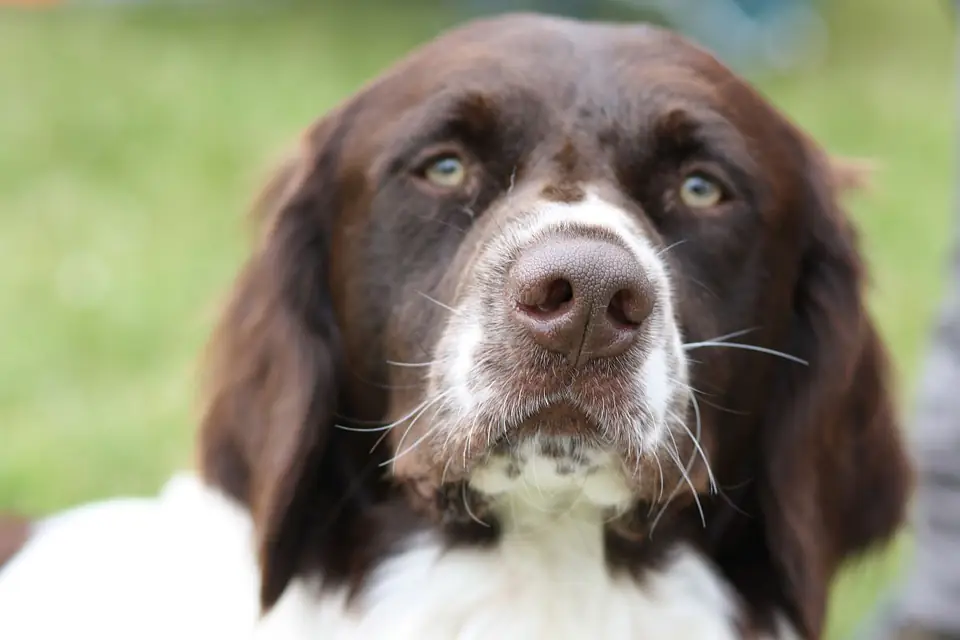
The Drentsche Patrijshond is a Dutch farm gundog from the province of Drenthe, kept as an all rounder that pointed and retrieved game, cleared vermin and watched the yard. This is a medium sized dog with a white coat marked in brown or orange, feathering on the legs and tail, and a soft, open expression. Drents are sociable and sensitive, stay close to their people, are notably quiet in the house, and rate at the top of the scale with both children and other pets.
A sedentary home will not suit a Drent. They want a proper daily outing, hiking, running, canicross or scentwork, and they will keep going all day. The half long coat needs a weekly brush and heavier sessions when the undercoat drops, and the ear feathering needs stripping and checking. Training works through relationship rather than pressure, since a harsh correction shuts this dog down. Train with a light touch and resist drilling them like a hard headed gundog.
What to expect at eight weeks
At eight weeks a Drentsche Patrijshond puppy is sleeping around 18 to 20 hours a day, is not house trained, and cannot hold on for more than an hour or two at a stretch. A large breed puppy at eight weeks looks deceptively normal sized and will roughly double every few weeks for a while. Keep exercise short and low impact, the growth plates are wide open. Expect moderate energy, in short bursts separated by long naps. Grooming needs are moderate, so build the brushing habit now while the coat is still short and easy. The socialisation window is open and closing: everything they meet calmly now, from vacuum cleaners to men in hats, is easier for the rest of their life.
Health worth knowing about
Conditions this breed is reported to be predisposed to. Predisposed does not mean inevitable, it means ask about it.
- Progressive retinal atrophy and other inherited eye disease, screened by an ophthalmologist eye exam
- Entropion and ectropion of the eyelids, found on the same eye examination
- Von Willebrand's disease type I, detectable by DNA test, though affected Drents rarely show clinical bleeding
- Epilepsy, considered the breed's main health concern and diagnosed by ruling out other causes of seizures
- Hip and elbow dysplasia, screened by x-ray evaluation of breeding stock
- Hypothyroidism, found on a thyroid blood panel
Your Drentsche Patrijshond puppy's first six months
- Vaccination schedule, dated for your country.
- Worming and parasite schedule.
- Feeding calculator. Set expected adult size to Large for a Drentsche Patrijshond.
- Adult size predictor, to check growth against the 24.9 to 33.1 kg adult range.
- Puppy names and the first week checklist.
Kit sizes: crate 42 inch (42 x 28 x 30 in, 107 x 71 x 76 cm) for an adult of up to 33.1 kg; chew toys made for large breeds. Worked out the same way as the crate size calculator. PetMD bases a crate on the dog's own measurements, not weight or breed alone, so measure once the puppy is home.
Buying guides for this
Other large breeds
More on the Drentsche Patrijshond
Previous: Doxiepoo · Next: Drever
Not veterinary advice. Breed information is general. Your own dog, and your own vet, always win.
Sources
- akc.org for adult weight and height, life expectancy, energy, grooming, shedding and the temperament ratings, coat type and health notes
- fci.be for country of origin
- Health notes from Drentsche Patrijshond breed information at https://www.akc.org/dog-breeds/drentsche-patrijshond/. Discuss any of these with your own vet.
Photo: mjk23, CC BY 2.0, via Wikimedia Commons, cropped. All photographers are listed on the photo credits page.