Breeds / Large
Curly-Coated Retriever puppies
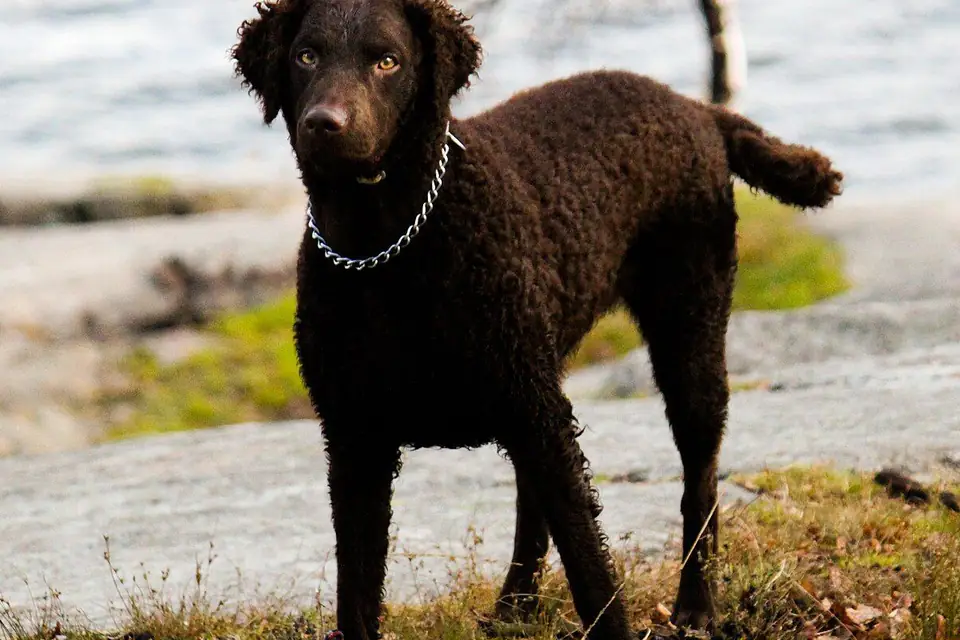
A tall, curly coated British retriever, confident and playful with their own family, more aloof with strangers than other retrievers and slow to mature.
The facts
- Size class Large
- Country of origin Great Britain
- Adult weight 27.2 to 43.1 kg
- Adult weight in pounds 60 to 95 lb
- Adult height 58 to 69 cm
- Energy level High
- Grooming Low
- Coat type Short curly and double
- Shedding Low
- Typical lifespan 10 to 12 years
- Good with children Reliably good
- Good with other dogs Fine with supervision
About the Curly-Coated Retriever
The Curly-Coated Retriever is one of the oldest retriever breeds, developed in Britain to work wildfowl out of cold water and heavy cover. They stand 58 to 69 cm and weigh 27.2 to 43.1 kg, taller and leggier than most retrievers, and the coat of tight crisp curls sits directly on the skin with no undercoat, shedding water and thorns alike. Temperament sets them apart from their cousins: confident and playful at home, more reserved with strangers, and slow to grow up mentally.
Energy is high and they need proper work, swimming, retrieving or field sport, after which they settle happily indoors even in a small house. Grooming is refreshingly simple: wet the coat down and let it air dry, use a rake during the shed, and do not brush it or the curls frizz. They do badly left alone for long stretches. Give a late maturing Curly time, and do not push training fast in the hope of a Labrador temperament.
What to expect at eight weeks
At eight weeks a Curly-Coated Retriever puppy is sleeping around 18 to 20 hours a day, is not house trained, and cannot hold on for more than an hour or two at a stretch. A large breed puppy at eight weeks looks deceptively normal sized and will roughly double every few weeks for a while. Keep exercise short and low impact, the growth plates are wide open. This is a high energy breed. At eight weeks that shows up as intensity rather than stamina, and they will need a job to do long before they need long walks. Grooming is straightforward, but start handling the coat, feet and ears in week one anyway so it is never a fight later. The socialisation window is open and closing: everything they meet calmly now, from vacuum cleaners to men in hats, is easier for the rest of their life.
Health worth knowing about
Conditions this breed is reported to be predisposed to. Predisposed does not mean inevitable, it means ask about it.
- Hip and elbow dysplasia, screened by hip and elbow evaluation of breeding stock
- Progressive retinal atrophy, detectable by DNA test on both parents
- Glaucoma and other inherited eye disease, screened by an ophthalmologist evaluation
- Exercise induced collapse (EIC), detectable by DNA test
- Bloat and gastric torsion, a surgical emergency in deep chested dogs
- Cancer, which the parent club tracks in the breed and which needs prompt investigation of any new lump or unexplained weight loss
Your Curly-Coated Retriever puppy's first six months
- Vaccination schedule, dated for your country.
- Worming and parasite schedule.
- Feeding calculator. Set expected adult size to Large for a Curly-Coated Retriever.
- Adult size predictor, to check growth against the 27.2 to 43.1 kg adult range.
- Puppy names and the first week checklist.
Kit sizes: crate 48 inch (48 x 30 x 32 in, 122 x 76 x 81 cm) for an adult of up to 43.1 kg; chew toys made for large breeds. Worked out the same way as the crate size calculator. PetMD bases a crate on the dog's own measurements, not weight or breed alone, so measure once the puppy is home.
Buying guides for this
Other large breeds

More on the Curly-Coated Retriever
Previous: Croatian Sheepdog · Next: Czechoslovakian Vlciak
Not veterinary advice. Breed information is general. Your own dog, and your own vet, always win.
Sources
- akc.org for adult weight and height, life expectancy, energy, grooming, shedding and the temperament ratings, coat type and health notes
- fci.be for country of origin
- Health notes from Curly-Coated Retriever breed information at https://www.akc.org/dog-breeds/curly-coated-retriever/. Discuss any of these with your own vet.
Photo: Mattias Agar, CC BY-SA 2.0, via Wikimedia Commons, cropped. All photographers are listed on the photo credits page.