Breeds / Large
Clumber Spaniel puppies
A heavy, low slung British gundog with a gentle, deliberate manner, quiet in the house, affectionate with their own people and quietly stubborn about anything they would rather not do.
The facts
- Size class Large
- Country of origin Great Britain
- Adult weight 24.9 to 38.6 kg
- Adult weight in pounds 55 to 85 lb
- Adult height 43 to 51 cm
- Energy level Moderate
- Grooming Moderate
- Coat type Medium wavy and silky
- Shedding Moderate
- Typical lifespan 10 to 12 years
- Good with children Fine with supervision
- Good with other dogs Fine with supervision
About the Clumber Spaniel
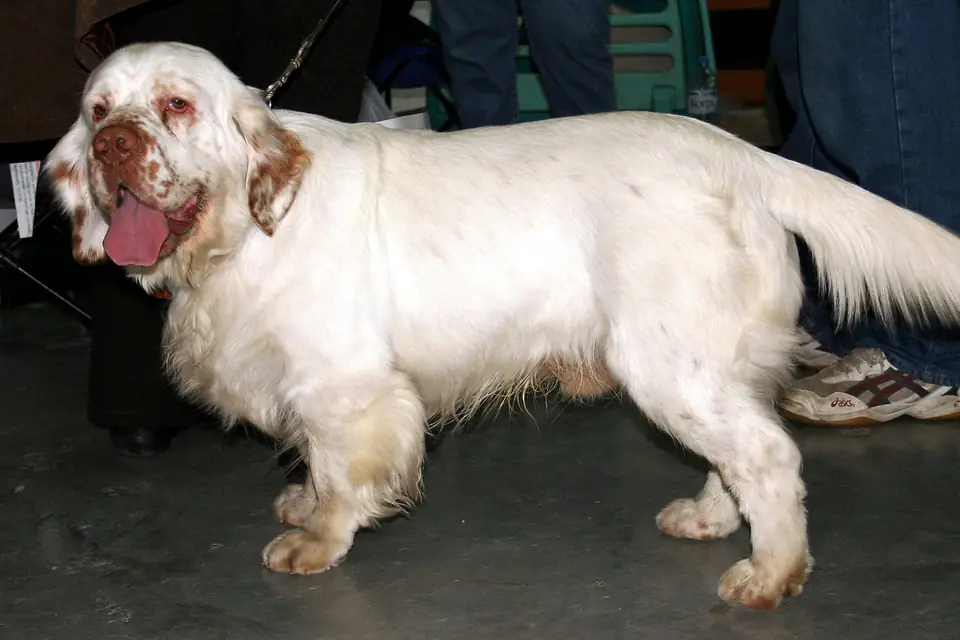
The Clumber Spaniel is the heaviest of the British gundog spaniels, bred to push slowly and methodically through dense cover ahead of walking guns rather than to quarter a field at speed. They are long and low, 24.9 to 38.6 kg on legs that put them only 43 to 51 cm at the shoulder, with heavy bone, a white coat marked lemon or orange, a big square head and loose flews. They are mellow, quietly funny, notably silent for a spaniel, and stubborn when they want to be.
Exercise is moderate: long sniffing walks and retrieving games in the garden suit them better than sustained running. Grooming means a comb through once or twice a week, monthly baths, and regular wiping of the head folds and cleaning of the heavy low set ears. They drool and they shed, so they suit a relaxed home. The main risk is weight, because extra kilos on that long back and heavy frame turn straight into joint and disc trouble.
What to expect at eight weeks
At eight weeks a Clumber Spaniel puppy is sleeping around 18 to 20 hours a day, is not house trained, and cannot hold on for more than an hour or two at a stretch. A large breed puppy at eight weeks looks deceptively normal sized and will roughly double every few weeks for a while. Keep exercise short and low impact, the growth plates are wide open. Expect moderate energy, in short bursts separated by long naps. Grooming needs are moderate, so build the brushing habit now while the coat is still short and easy. The socialisation window is open and closing: everything they meet calmly now, from vacuum cleaners to men in hats, is easier for the rest of their life.
Health worth knowing about
Conditions this breed is reported to be predisposed to. Predisposed does not mean inevitable, it means ask about it.
- Hip dysplasia, screened by hip evaluation of breeding stock
- Entropion and ectropion, eyelids that roll in or droop out, found on an eye exam and corrected surgically
- Hypothyroidism, screened by a thyroid evaluation, often first noticed as skin and ear problems
- Intervertebral disc disease, which shows as back or neck pain and hind limb weakness and is confirmed by imaging
- Panosteitis, a painful growing bone condition in young dogs that shows on x-ray and is usually outgrown
- Immune mediated haemolytic anaemia, diagnosed on blood work, and a reason the breed should avoid sulfa drugs
Your Clumber Spaniel puppy's first six months
- Vaccination schedule, dated for your country.
- Worming and parasite schedule.
- Feeding calculator. Set expected adult size to Large for a Clumber Spaniel.
- Adult size predictor, to check growth against the 24.9 to 38.6 kg adult range.
- Puppy names and the first week checklist.
Kit sizes: crate 42 inch (42 x 28 x 30 in, 107 x 71 x 76 cm) for an adult of up to 38.6 kg; chew toys made for large breeds. Worked out the same way as the crate size calculator. PetMD bases a crate on the dog's own measurements, not weight or breed alone, so measure once the puppy is home.
Buying guides for this
Other large breeds



Previous: Cirneco dell’Etna · Next: Cockalier
Not veterinary advice. Breed information is general. Your own dog, and your own vet, always win.
Sources
- akc.org for adult weight and height, life expectancy, energy, grooming, shedding and the temperament ratings, coat type and health notes
- fci.be for country of origin
- Health notes from Clumber Spaniel breed information at https://www.akc.org/dog-breeds/clumber-spaniel/. Discuss any of these with your own vet.
Photo: Pleple2000, CC BY-SA 3.0, via Wikimedia Commons, cropped. All photographers are listed on the photo credits page.