Breeds / Large
Chesapeake Bay Retriever puppies
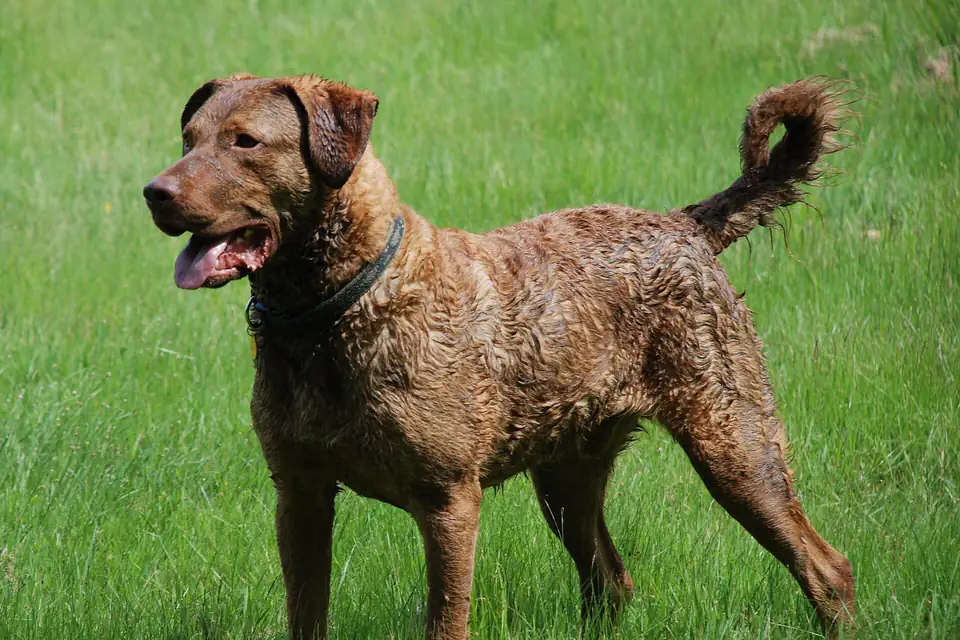
Loyal, upbeat and affectionate, the Chesapeake Bay Retriever is a tough cold water duck dog with a harsh oily coat. They are more reserved with strangers and more independent minded than the other retrievers.
The facts
- Size class Large
- Country of origin United States
- Adult weight 24.9 to 36.3 kg
- Adult weight in pounds 55 to 80 lb
- Adult height 53 to 66 cm
- Energy level High
- Grooming Moderate
- Coat type Medium wavy and wiry
- Shedding Moderate
- Typical lifespan 10 to 13 years
- Good with children Fine with supervision
- Good with other dogs Fine with supervision
About the Chesapeake Bay Retriever
The Chesapeake Bay Retriever was built around one job: bringing ducks out of the cold, rough water of the Chesapeake, sometimes dozens of birds in a day. They descend from two shipwrecked Newfoundland type dogs bred to local retrievers, and it shows in a powerful frame of 24.9 to 36.3 kg standing 53 to 66 cm, with a harsh oily wavy coat that sheds water and a deadly serious attitude to retrieving. They are warmer with their own family than with strangers.
A Chessie has high energy and needs a job rather than a stroll. Swimming, field work, tracking and dog sports all suit them. Grooming is a weekly brush, and frequent bathing is a mistake because it strips the oils out of the coat. They fit an active, consistent owner who trains fairly and firmly. Do not expect a Labrador: the Chessie is more independent, more protective and less forgiving of muddled handling.
What to expect at eight weeks
At eight weeks a Chesapeake Bay Retriever puppy is sleeping around 18 to 20 hours a day, is not house trained, and cannot hold on for more than an hour or two at a stretch. A large breed puppy at eight weeks looks deceptively normal sized and will roughly double every few weeks for a while. Keep exercise short and low impact, the growth plates are wide open. This is a high energy breed. At eight weeks that shows up as intensity rather than stamina, and they will need a job to do long before they need long walks. Grooming needs are moderate, so build the brushing habit now while the coat is still short and easy. The socialisation window is open and closing: everything they meet calmly now, from vacuum cleaners to men in hats, is easier for the rest of their life.
Health worth knowing about
Conditions this breed is reported to be predisposed to. Predisposed does not mean inevitable, it means ask about it.
- Hip and elbow dysplasia, screened by hip and elbow evaluation of breeding stock
- Progressive retinal atrophy (prcd-PRA), detectable by DNA test
- Exercise induced collapse (EIC), detectable by DNA test
- Degenerative myelopathy (DM), detectable by DNA test
- Other inherited eye disease, detected by a veterinary ophthalmologist exam
Your Chesapeake Bay Retriever puppy's first six months
- Vaccination schedule, dated for your country.
- Worming and parasite schedule.
- Feeding calculator. Set expected adult size to Large for a Chesapeake Bay Retriever.
- Adult size predictor, to check growth against the 24.9 to 36.3 kg adult range.
- Puppy names and the first week checklist.
Kit sizes: crate 42 inch (42 x 28 x 30 in, 107 x 71 x 76 cm) for an adult of up to 36.3 kg; chew toys made for large breeds. Worked out the same way as the crate size calculator. PetMD bases a crate on the dog's own measurements, not weight or breed alone, so measure once the puppy is home.
Buying guides for this
Other large breeds




More on the Chesapeake Bay Retriever
Previous: Cesky Terrier · Next: Chihuahua
Not veterinary advice. Breed information is general. Your own dog, and your own vet, always win.
Sources
- akc.org for adult weight and height, life expectancy, energy, grooming, shedding and the temperament ratings, coat type and health notes
- fci.be for country of origin
- Health notes from Chesapeake Bay Retriever breed information at https://www.akc.org/dog-breeds/chesapeake-bay-retriever/. Discuss any of these with your own vet.
Photo: Keith Rousseau, CC BY-SA 3.0, via Wikimedia Commons, cropped. All photographers are listed on the photo credits page.