Breeds / Large
Briard puppies
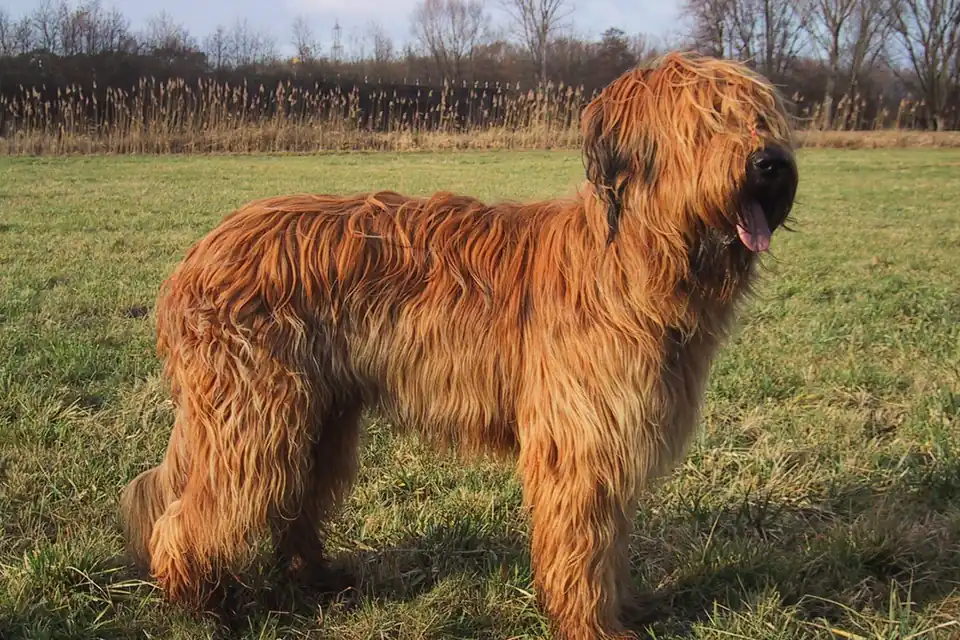
Loyal, confident and deeply attached to their family, the Briard is a large French herding breed under a long wavy coat. They are reserved with strangers, retain a strong herding instinct and need early socialisation.
The facts
- Size class Large
- Country of origin France
- Adult weight 24.9 to 45.4 kg
- Adult weight in pounds 55 to 100 lb
- Adult height 56 to 69 cm
- Energy level Moderate
- Grooming High
- Coat type Long wavy and double
- Shedding Low
- Typical lifespan 12 years
- Good with children Fine with supervision
- Good with other dogs Fine with supervision
About the Briard
The Briard is an old French herding dog from the plains of Brie, used to move and guard flocks and later to carry messages and find wounded soldiers in wartime. To look at, this is a big, muscular dog under a long wavy coat, with hair falling over the eyes, a full beard and double dewclaws on each hind leg. They are affectionate and rather serious, strongly bonded to their household, watchful with strangers, and inclined to herd whatever they happen to live with.
A Briard wants a job. Hiking, running or cycling alongside their owner, plus a large secure area to run free in, suits them far better than a routine of short walks. The coat is the real commitment: brushing several times a week right down to the skin, with an undercoat rake to clear dead hair, or it mats badly. They are independent minded and need early socialisation. Owners underestimate the grooming, then give up and have the coat clipped off.
What to expect at eight weeks
At eight weeks a Briard puppy is sleeping around 18 to 20 hours a day, is not house trained, and cannot hold on for more than an hour or two at a stretch. A large breed puppy at eight weeks looks deceptively normal sized and will roughly double every few weeks for a while. Keep exercise short and low impact, the growth plates are wide open. Expect moderate energy, in short bursts separated by long naps. Grooming needs are high. Start daily brushing and short, positive handling sessions at eight weeks, well before the adult coat arrives, or the first professional groom will be traumatic. The socialisation window is open and closing: everything they meet calmly now, from vacuum cleaners to men in hats, is easier for the rest of their life.
Health worth knowing about
Conditions this breed is reported to be predisposed to. Predisposed does not mean inevitable, it means ask about it.
- Hip dysplasia, screened by radiographic hip evaluation of breeding stock
- Congenital stationary night blindness, detectable by DNA test
- Cataracts, corneal dystrophy and retinal folds, found on an ophthalmologist evaluation
- Hypothyroidism, screened by a thyroid blood panel
- Exocrine pancreatic insufficiency, diagnosed by a blood test for trypsin like immunoreactivity
- Kidney disease, monitored by blood and urine testing
- Cancer, which is why lumps and unexplained weight loss should be checked early
Your Briard puppy's first six months
- Vaccination schedule, dated for your country.
- Worming and parasite schedule.
- Feeding calculator. Set expected adult size to Large for a Briard.
- Adult size predictor, to check growth against the 24.9 to 45.4 kg adult range.
- Puppy names and the first week checklist.
Kit sizes: crate 48 inch (48 x 30 x 32 in, 122 x 76 x 81 cm) for an adult of up to 45.4 kg; chew toys made for large breeds. Worked out the same way as the crate size calculator. PetMD bases a crate on the dog's own measurements, not weight or breed alone, so measure once the puppy is home.
Buying guides for this
Other large breeds



More on the Briard
Previous: Brazilian Terrier · Next: Brittany
Not veterinary advice. Breed information is general. Your own dog, and your own vet, always win.
Sources
- akc.org for adult weight and height, life expectancy, energy, grooming, shedding and the temperament ratings, coat type and health notes
- fci.be for country of origin
- Health notes from Briard breed information at https://www.akc.org/dog-breeds/briard/. Discuss any of these with your own vet.
Photo: Birgit Balzer, Deutschland), CC BY-SA 3.0, via Wikimedia Commons, cropped. All photographers are listed on the photo credits page.